
Sequencing a human genome now costs a few hundred dollars. Interpreting the result is still the bottleneck. One tumor panel can return hundreds of variants, and most of them remain unclassified. AI and genomics personalized medicine begins in exactly this gap. In this article, we look at three real systems. Each one uses machine learning to turn raw genomic data into decisions that personalize patient care.
The Role of AI in Genomics: What This Article Covers
AI has emerged as a practical toolset for genomic medicine, covering a wide set of AI techniques. Two terms matter most here. Machine learning learns patterns from labeled examples, such as variants already linked to disease. Deep learning is one branch of machine learning. It uses artificial neural networks with many layers and can learn directly from raw DNA sequence. In practice, both machine learning and deep learning now support the integration of AI into genomics at three levels.
- Variant interpretation. An AI model scores which variants are likely to harm the patient.
- Drug-response prediction. A model links a tumor’s genomic profile to drug sensitivity.
- Tumor classification. A model assigns a tumor to its most likely tissue of origin.
Each level has real systems behind it, and each application of AI rests on one peer-reviewed study. These are research and clinical applications already in use at major centers. The role of AI is the same in all three. These AI methods compress a volume of genomics data that no team can review by hand. They turn that volume into a short list of testable, highly personalized options. Together, these uses of AI define what AI and genomics-personalized medicine look like in practice today.
Why the Use of Artificial Intelligence in Genomic Medicine Matters Now
The volume of genomic data has outgrown manual review. One clinical exome yields tens of thousands of variants per patient. A large hospital sequences thousands of patients each year. Precision medicine depends on reading those variants correctly, and misreadings cost delayed diagnoses and mismatched cancer treatment. The use of artificial intelligence in genomic interpretation changes this arithmetic. In this setting, AI plays the interpreter. AI in genomics makes faster rare-disease diagnosis and better treatment matching realistic at scale. It also means more personalized treatments and fewer unanswered tests.
Deep Learning That Finds Hidden Mutations: SpliceAI and Rare-Disease Diagnosis
Most diagnostic pipelines search for variants that change a protein. SpliceAI looks somewhere else. Jaganathan and colleagues published it in Cell in 2019 [1]. It is a 32-layer deep neural network that predicts RNA splicing directly from DNA sequence. Splicing errors can break a gene even when the protein code looks intact. Standard exome analysis often misses the responsible variant.
The team tested the AI system on rare-disease cases that sequencing had left unsolved. RNA sequencing confirmed 75% of the predicted cryptic splice variants. Among patients with intellectual disability, the predictions pointed to a diagnosis in 21 of 28 tested patients. The authors estimate that 9-11% of pathogenic mutations in rare genetic disorders come from this overlooked class. Here, deep learning closes a diagnostic gap that exome sequencing alone leaves open. It also shows how AI can help identify causes that standard pipelines miss.
Machine Learning and Drug Response: Matching Cancer Genomics to the Right Treatment
A second use of AI connects cancer genomics to treatment response. In a 2016 Cell study, Iorio and colleagues screened 1,001 cancer cell lines against 265 anti-cancer drugs [2]. They then applied machine learning to link genomic alterations to drug sensitivity across the whole panel.
Two findings matter for precision oncology. First, a tumor’s tissue of origin strongly shapes which drugs work. Second, combinations of genomic alterations predicted sensitivity better than single markers. For treatment planning, such an AI model ranks candidate targeted therapies. The ranking starts from the tumor’s own genomic profile. That ranking cannot replace clinical judgment. It can focus a molecular tumor board on the options most worth discussing for a given cancer type. Studies of this kind give AI and genomics personalized medicine its working evidence base. They also inform the personalized treatment strategies now entering clinical trials.
AI in Cancer: Machine Learning That Traces a Tumor Back to Its Origin
Cancer of unknown primary accounts for 3-5% of all cancers. Standard imaging and pathology cannot find where the tumor started. Most approved therapies target a specific cancer type, so options stay limited. Moon and colleagues built OncoNPC to address this problem and published it in Nature Medicine in 2023 [3]. The classifier learned from sequencing data on 36,445 tumors across 22 cancer types.
The team then applied OncoNPC to 971 cancers of unknown primary. The model predicted the tumor’s origin with high confidence in 41.2% of cases. Patients whose first treatment matched the prediction lived markedly longer, with a hazard ratio of 0.348 (95% CI, 0.210-0.570). The model also identified 2.2 times more patients who could receive genomically guided therapies. These results come from retrospective data, so prospective validation is still needed. Even so, this AI in cancer study moves from research code toward clinical decision support. It can reshape the treatment plan for patients with few options in cancer care. It also shows how AI algorithms can detect patterns that standard workups miss.
The Future Power of AI in Genomic Medicine
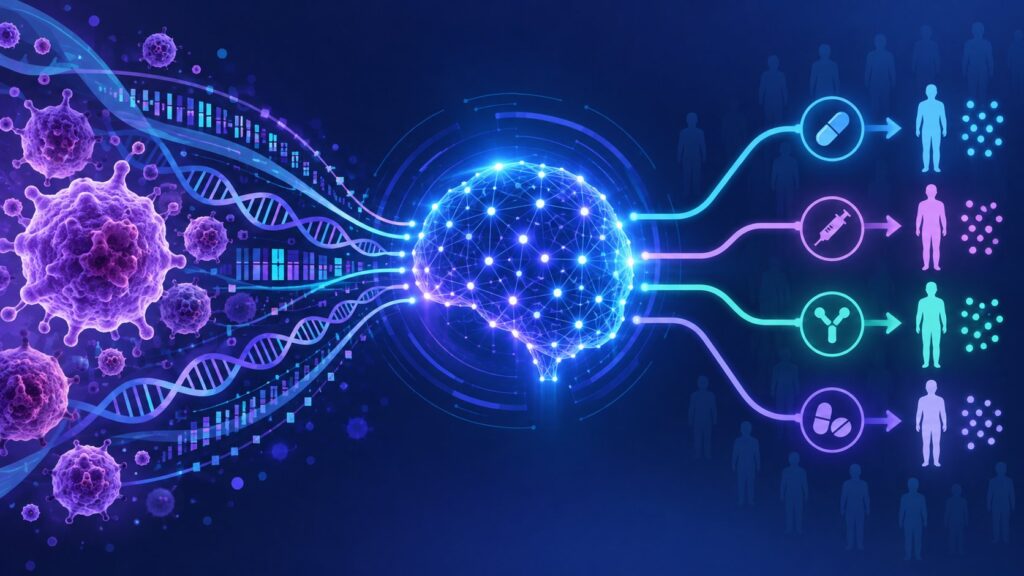
The next wave is already visible. AI models trained on millions of genomes and single-cell profiles, often called foundation models, aim to generalize across tasks. AI could extend the same logic to polygenic risk scores. That would widen AI in precision medicine beyond oncology. In the wider field of precision medicine, AI is also entering pharmacogenomics at the scale of whole health systems. AI can also combine genomic data with electronic health records, which sharpens predictions about health conditions before symptoms appear. We covered one such use of AI in our article on predicting disease before symptoms.
The barriers are equally concrete. New AI approaches need external validation on data from hospitals other than the ones that trained them. Training sets still underrepresent many populations, and bias in AI follows from biased data. Clinicians also need explainable AI: scores they can interrogate and explain to patients. Pre-specified analysis plans help, as we described in our guide to statistical analysis plans for clinical trials. Regulation and the interpretability of AI will set the pace for the adoption of AI in clinical practice. The acceptance of AI among clinicians will follow. Some clinicians prefer the term augmented intelligence, since these systems extend human intelligence. For AI and genomics personalized medicine, one condition holds: current and future benefits of AI depend on that validation work. The power of AI is real, and so are its limits. Used well, these AI tools could transform patient care.
Contact Us About Integrating AI in Healthcare
AI and genomics personalized medicine now raises practical questions for many healthcare organizations. Which AI technologies should they trust? How should they validate them on local data and fit them into daily work to improve patient care? We help teams answer these questions about AI in healthcare. Our work ranges from independent review of AI models to genomic medicine program design. If you are exploring the integration of artificial intelligence in medicine, contact us. We will help you define what a realistic project looks like.
References
- Jaganathan, Kishore, et al. “Predicting Splicing from Primary Sequence with Deep Learning.” Cell, vol. 176, no. 3, 2019, pp. 535-548, pubmed.ncbi.nlm.nih.gov/30661751/.
- Iorio, Francesco, et al. “A Landscape of Pharmacogenomic Interactions in Cancer.” Cell, vol. 166, no. 3, 2016, pp. 740-754, doi.org/10.1016/j.cell.2016.06.017.
- Moon, Intae, et al. “Machine Learning for Genetics-Based Classification and Treatment Response Prediction in Cancer of Unknown Primary.” Nature Medicine, vol. 29, no. 8, 2023, pp. 2057-2067, nature.com/articles/s41591-023-02482-6.