
Clinical validation of AI in healthcare proves that an algorithm works on real patients in real clinics. However, technical checks only measure accuracy on test data. In contrast, clinical testing measures safety and benefit in actual patient care. Below, we explain the core concepts and walk through three recent studies of artificial intelligence. Then we look ahead.
What Clinical Validation of an AI Model Means for a Medical Device
Every AI model needs three tests before clinicians can trust it. First, internal validation uses held-out data from the training source. It shows that the model learned something, but it hides site-specific bias. Second, independent validation on data from other hospitals shows how the model handles new scanners and new patients. Third, a prospective study tests the tool in live clinical practice. Together, these steps form clinical validation of AI in healthcare.
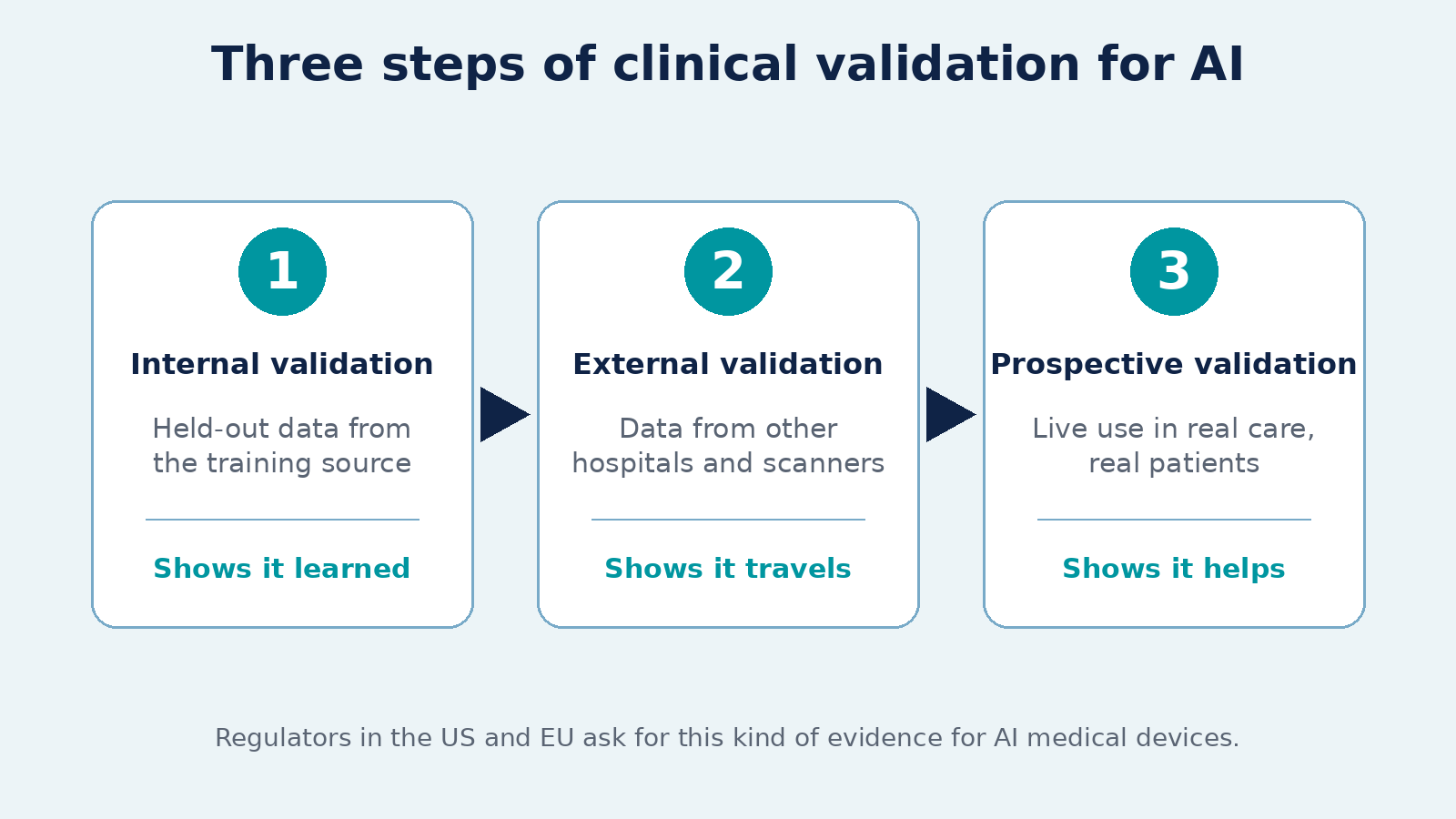
Regulators ask for the same evidence. In the United States, the FDA decides whether software counts as a device. Its clinical decision support software guidance [1] lists the criteria. For example, software that analyzes medical images usually qualifies as a medical device. In the European Union, Regulation (EU) 2017/745 [2] covers software intended for medical purposes and requires clinical evaluation.
Clinical decision support tools give clinicians patient-specific information to guide a choice. However, some stay outside the device definition. Still, image-based tools often fall inside it.
Why Clinical Validation Matters for AI in Healthcare
A wrong output can delay treatment or trigger false alarms, as our overview of the risks of artificial intelligence in medicine explains. It can also widen gaps between patient groups. Hospitals, insurers, and regulators therefore want proof before they approve clinical AI. The American Medical Association [3] reports that 81% of physicians now use AI, so the adoption of AI keeps growing. Clinical validation of AI in healthcare protects patient outcomes as that growth continues.
Four risks explain why:
- Scanner and site shift: a new camera or protocol changes the images that the model sees.
- Different patient populations: age, ethnicity, and disease mix vary between hospitals.
- Data drift: coding habits and treatments change, and accuracy slowly drops.
- Biased training sets: groups missing from the training data often get worse predictions.
Each risk has a matching test. The three cases below show those tests at work.
External Validation of a Deep Learning System for Glaucoma Detection on Fundus Photographs
A team from Qilu Hospital of Shandong University [4] tested a deep learning model that flags glaucomatous optic neuropathy on fundus photographs. Tencent Healthcare built the system on 20,877 training images. The researchers then ran an external validation study. The test sets held 3,049 images from Qilu Hospital and 7,495 images from three other Chinese hospitals. In addition, a third set held 516 images from patients with high myopia. Moreover, two ophthalmologists and one senior glaucoma specialist set the reference standard.
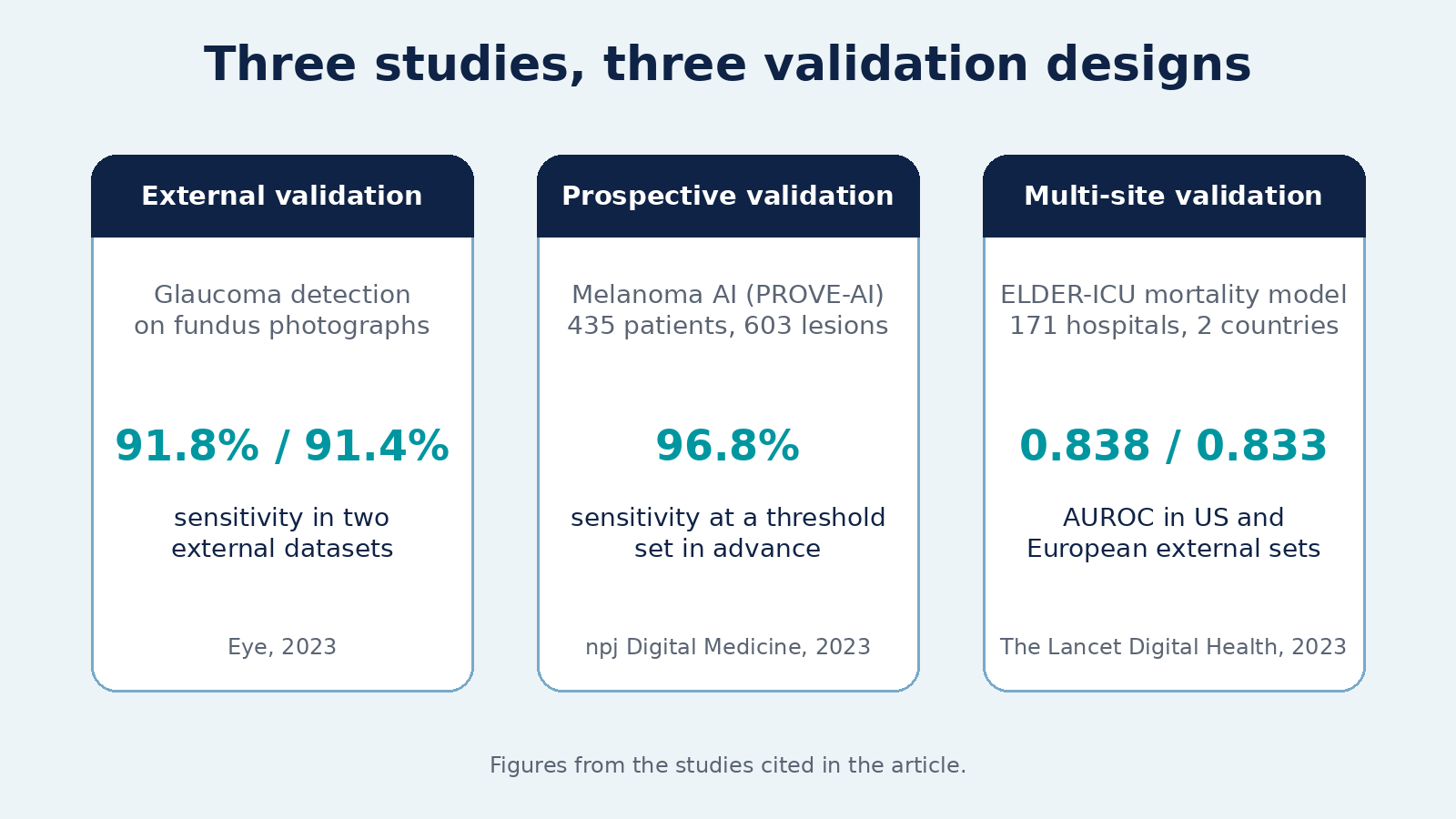
The AUC reached 0.952 and 0.966 in the first two datasets. Overall, sensitivity was 91.8% and 91.4%. The two manual graders reached 78.8% and 92.8% in the first set, and 60.3% and 79.4% in the second. Next, specificity was 93.4% and 92.2%, slightly below the graders. In high myopia, accuracy fell to 81.98%.
In addition, the study was retrospective and used only Chinese patients. Thus, the authors flag both points as limits. For a clinic, the lesson is direct: performance changes with image quality, site, and eye condition. Therefore, test the tool on your own cameras and patient data first. Our article on AI in medical imaging covers more imaging use cases.
Prospective Validation of an Open-Source AI for Melanoma Diagnosis (PROVE-AI)
The PROVE-AI study at Memorial Sloan Kettering [5] tested an open-source algorithm on real patients. The model had won the 2020 International Skin Imaging Collaboration challenge. Yet it trained only on public dermoscopy images. The team enrolled 435 participants with 603 skin lesions. Every lesion went to biopsy, and pathology found 95 melanomas. Finally, eleven dermatologists took part.
The researchers fixed the decision threshold at 95% sensitivity before the study began. As a result, the algorithm reached 96.8% sensitivity and 37.4% specificity. Dermatologists rated each lesion before and after they saw the AI score. Consequently, their AUC rose from 0.7798 to 0.8161 (p = 0.042). After the AI score, their biopsy decisions had equal or higher net benefit than biopsying every lesion.
However, specificity was lower in patients aged 65 and older. Also, 96% of participants were White. However, the authors call for randomized trials before wide use. This study shows what a prospective design adds: real lesions, real doctors, and a threshold chosen in advance.
International Multi-Site Validation of ELDER-ICU for Older Adults in Critical Care
ELDER-ICU is a machine learning model that predicts in-hospital mortality for intensive care patients over 65. Researchers [6] trained it on 50,366 patients from 14 US hospitals. They then validated it in 171 hospitals in the USA and the Netherlands. The inputs were routine first-day data, such as vital signs, laboratory tests, and frailty.
The AUROC was 0.866 in internal validation and 0.838 in 20,541 US patients from 169 hospitals. It was 0.833 in 2,411 patients from one European hospital. Finally, temporal validation on newer data gave 0.884. The team also tested eight subgroups by age, sex, and race. Overall, median AUROCs stayed above 0.81, and the overall standardized mortality ratio was 0.99. However, scores dipped slightly in older and female patients.
This subgroup check matters for clinical decision-making. In other words, it shows whether the model works fairly across groups, and not only on average. The authors still call for prospective trials and continuous monitoring.
Why Clinical Validation Will Matter Even More for Clinical AI in the Future
Approval will no longer be a one-time event. Models change, and so does the data they see. The FDA [7] now publishes guidance on predetermined change control plans. In short, these plans let manufacturers update an AI-enabled device within pre-agreed limits. Monitoring after launch will become routine, as the ELDER-ICU authors [6] also recommend.
Large language models add a new layer, and deep learning in healthcare keeps widening. They already support clinical care tasks, and they need their own validation studies. Regulators and buyers will also expect evidence from diverse patient groups. Clinical validation of AI in healthcare will therefore move from a bonus to a baseline.
We expect hospitals to treat validated AI tools as a purchase requirement. A practical first step is simple. First, ask every vendor for external and prospective results, and ask how they will monitor the product after launch. Our guide on how to evaluate AI tools in healthcare shows how to judge such evidence. Our AI in medicine consulting service can support that review.
Contact Us for Integration of AI in Healthcare
At Neural Board, we help healthcare organizations plan the clinical validation of AI in healthcare. In addition, we help you choose an AI system that fits your use case. We also set up external validation with your own data. Contact us to discuss your project.
References
- U.S. Food and Drug Administration. Clinical Decision Support Software: Guidance for Industry and Food and Drug Administration Staff. Jan. 2026, https://www.fda.gov/regulatory-information/search-fda-guidance-documents/clinical-decision-support-software.
- European Parliament and Council of the European Union. Regulation (EU) 2017/745 on Medical Devices. 5 Apr. 2017, https://eur-lex.europa.eu/eli/reg/2017/745/oj/eng.
- American Medical Association. “AI Usage Among Doctors Doubles as Confidence in Technology Grows.” 12 Mar. 2026, https://www.ama-assn.org/press-center/ama-press-releases/ama-ai-usage-among-doctors-doubles-confidence-technology-grows.
- Xu Qian, et al. “External Validation of a Deep Learning Detection System for Glaucomatous Optic Neuropathy: A Real-World Multicentre Study.” Eye, vol. 37, no. 18, 2023, pp. 3813-3818, https://doi.org/10.1038/s41433-023-02622-9. PMC full text: https://pmc.ncbi.nlm.nih.gov/articles/PMC10698045/.
- Marchetti, Michael A., et al. “Prospective Validation of Dermoscopy-Based Open-Source Artificial Intelligence for Melanoma Diagnosis (PROVE-AI Study).” npj Digital Medicine, 2023, https://doi.org/10.1038/s41746-023-00872-1.
- Liu, Xiaoli, et al. “Illness Severity Assessment of Older Adults in Critical Illness Using Machine Learning (ELDER-ICU): An International Multicentre Study with Subgroup Bias Evaluation.” The Lancet Digital Health, vol. 5, no. 10, 2023, https://doi.org/10.1016/S2589-7500(23)00128-0.
- U.S. Food and Drug Administration. Marketing Submission Recommendations for a Predetermined Change Control Plan for Artificial Intelligence-Enabled Device Software Functions. Aug. 2025, https://www.fda.gov/regulatory-information/search-fda-guidance-documents/marketing-submission-recommendations-predetermined-change-control-plan-artificial-intelligence.
Leave a Reply