
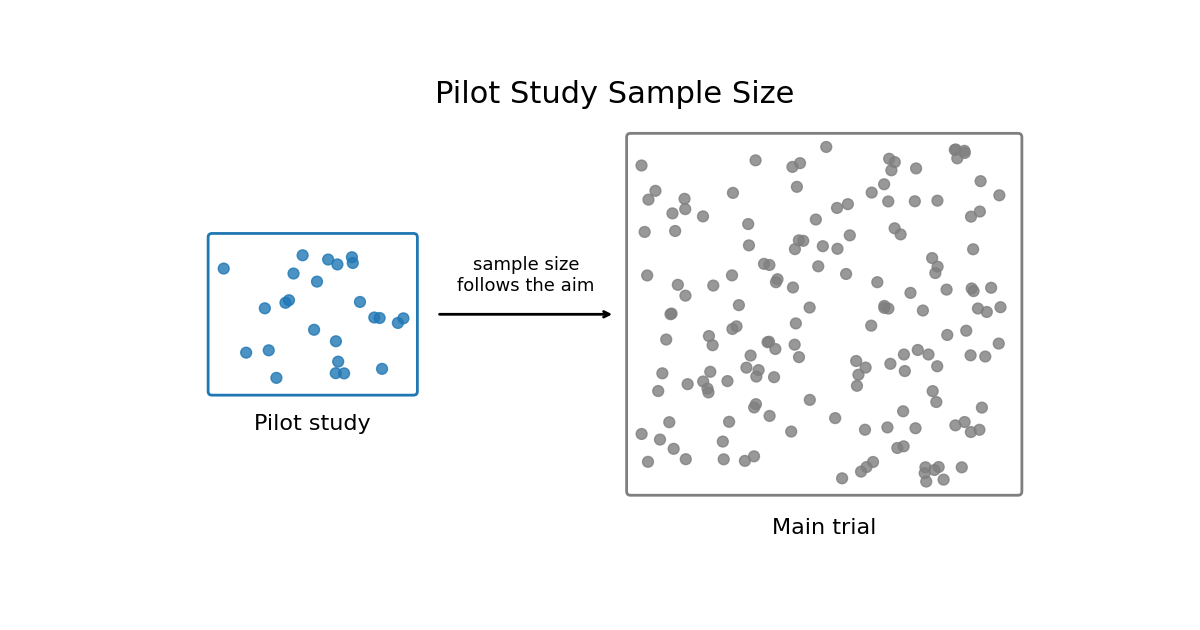
Pilot study sample size depends on what the pilot has to show. A pilot is a small test of methods. One that checks feasibility needs different numbers than one that estimates a standard deviation. Below, we compare three approaches: finding problems, estimating variability, and running a pilot phase inside a trial.
Sample Size Determination in Pilot Studies: Feasibility or Precision?
The right number of participants depends on the goal. For example, one pilot may check recruitment, eligibility rules, and questionnaire wording, so it needs enough participants to reveal those problems. In contrast, another pilot may estimate the standard deviation and needs enough participants for a usable estimate. Sample size determination therefore starts with a clear aim.
When no prior data exist, rules of thumb can guide pilot study sample size. Julious [1] recommends 12 participants per group, based on the precision of the mean and variance, practical aspects, and regulatory considerations. Teare and colleagues [2] recommend at least 70 measured participants, 35 per group. This applies to an external pilot that estimates the standard deviation of a normally distributed outcome before a two-arm trial. Adding five participants per group improves the precision of that estimate by less than 10% once the total reaches 70. However, the two figures differ in method and precision target, so they are not interchangeable.
Design matters as well. An external pilot stands apart from the main study, and its data stay out of the final analysis [3]. In contrast, an internal pilot is a phase within the main study, so its data enter the final analysis [3].
Why the Size of a Pilot Study Matters for the Full Study
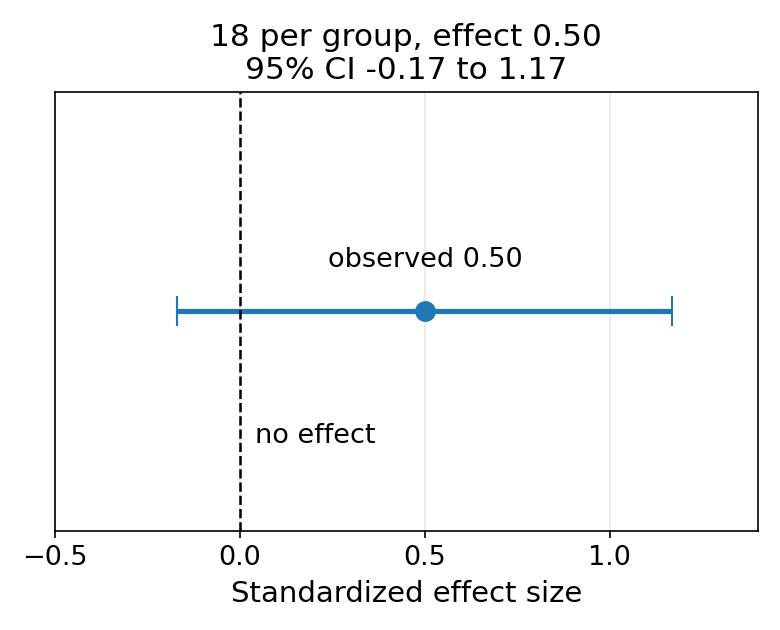
Pilot studies built on a small sample give shaky estimates. The size of a pilot study limits what it can tell you about the full study. Leon, Davis, and Kraemer show this with a simple case [4]. For example, take 18 participants per group and an observed effect size of 0.50. The approximate 95% confidence interval, 0.50 ± 0.67, runs from about -0.17 to 1.17 and includes zero. The data fit a slight harm, no effect, or a very large benefit. Planning numbers for the next study would therefore swing widely.
The authors conclude that a pilot should answer questions about design and conduct. They advise that the sample size of the main trial should rest on a clinically meaningful difference [4]. In addition, a statistical analysis plan for a clinical trial can record that rationale. Too small a sample is also one of the common statistical errors in medical research.
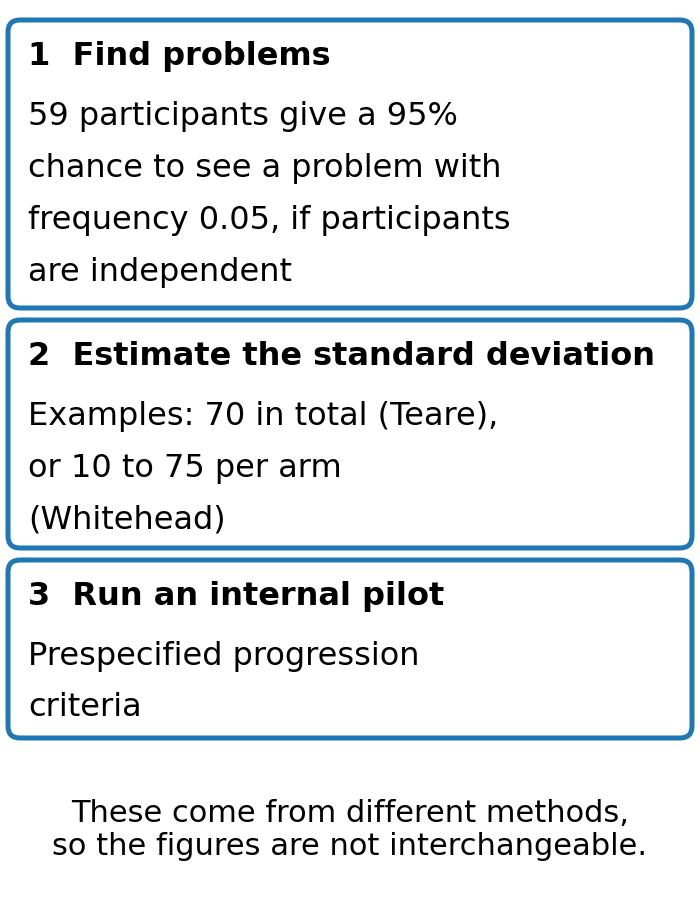
The three studies below answer different questions. How many participants reveal a problem? How many per arm give a usable standard deviation? And how do real trials use a pilot phase to decide whether to go on? Each study serves a different goal and has its own source.
A Simple Formula for the Calculation of Sample Size in Problem Detection
Many pilot studies look for problems, such as an unclear eligibility rule or a misread questionnaire item. Viechtbauer and colleagues [5] give a simple formula for the calculation of sample size in this case. The formula is n = ln(1 – confidence) / ln(1 – p). Here, p is the smallest problem frequency worth catching. In addition, the formula assumes each participant has the same probability p of showing the problem, independently of the others. For p = 0.05, 59 participants give at least a 95% probability of seeing the problem once or more. For p = 0.10 the pilot needs 29 participants, and for p = 0.15 it needs 19.
Finally, the authors link this to the rule of three, which gives roughly 3/p participants. However, rarer problems can still be missed at a given sample size. The formula serves problem detection only. It says nothing about precision or power, so a pilot that also estimates a standard deviation needs a different calculation, which we cover next.
Sample Size Calculation for a Pilot That Estimates the Standard Deviation
Whitehead and colleagues [6] ask how large the pilot should be. Their aim is to keep the total number of participants low across the pilot and the main trial together. The method assumes a two-arm parallel trial with a continuous outcome and a two-sided 5% significance level. In addition, it adjusts the size of the main trial for the imprecise standard deviation, using the non-central t approach. The exact optimum needs the planned standardized effect size, whereas the stepped rule needs only its category. The table lists the pilot size per arm by the power of the main trial.
| Standardized difference | Participants per arm, 80% power | Participants per arm, 90% power |
|---|---|---|
| Below 0.1 | 50 | 75 |
| 0.1 to below 0.3 | 20 | 25 |
| 0.3 to below 0.7 | 10 | 15 |
| 0.7 and above | 10 | 10 |
The authors set a floor of 10 participants per arm, so the pilot can still address other aims. As a result, a smaller expected difference calls for a larger pilot. This sample size calculation applies to continuous outcomes only, and the standard deviation comes from the pilot sample.
Internal Pilots in Practice: What 57 NIHR Trials Checked
Rosala-Hallas and colleagues [3] reviewed trials with an internal pilot funded by the UK National Institute for Health Research Health Technology Assessment programme. Of 74 eligible trials, 57 entered the review. Most specified progression criteria in the protocol, but 37% did not. Typical criteria were the recruitment target, the randomization rate, retention, adherence, and the consent rate. Of the 57 trials, 56 continued and one decision was still pending. Even so, 14 trials (25%) did not meet their criteria, and for nine it was unclear. In addition, the design of the main trial changed in 14 trials (25%), mostly the way recruitment was run.
The review shows what a pilot phase is for. It tests the plan while the trial is running, and its data enter the final analysis. The review covers progression criteria and offers no sample size formula. As a result, researchers who plan this design still need a separate rationale for pilot study sample size.
Sample Size in Pilot Studies: Where Planning Is Heading
The three papers share one view of sample size in pilot studies: justify it against a stated objective. Objectives include detecting problems, estimating a standard deviation, and meeting progression criteria. Pilot size should follow the aim, and habit and convenience carry less weight. Consequently, the figures from each source answer different questions and cannot be swapped. A rule of 12 per group, a total of 70, and a stepped value of 75 per arm each reflect a different aim. Pilot results also remain weak guides to treatment effects. In short, the pilot study sample size needs an aim before anyone picks a number. An adequately sized pilot is one whose size matches its stated aim.
Contact Us for Help With Pilot Study Design and Sample Size
If you plan a pilot and are unsure about pilot study sample size, we can help. We can review your pilot plan and its sample size in an independent biostatistical review, also before data collection starts. Contact us to discuss your current project and the main aim of your pilot.
References
- Julious, Steven A. “Sample Size of 12 per Group Rule of Thumb for a Pilot Study.” Pharmaceutical Statistics, vol. 4, no. 4, 2005, pp. 287-91. https://doi.org/10.1002/pst.185
- Teare, M. Dawn, et al. “Sample Size Requirements to Estimate Key Design Parameters from External Pilot Randomised Controlled Trials: A Simulation Study.” Trials, vol. 15, 2014, article 264. https://doi.org/10.1186/1745-6215-15-264
- Rosala-Hallas, Anna, et al. “A Review of Current Practice in the Design and Assessment of Internal Pilots in UK NIHR Clinical Trials.” Trials, vol. 20, 2019, article 571. https://doi.org/10.1186/s13063-019-3669-9
- Leon, Andrew C., et al. “The Role and Interpretation of Pilot Studies in Clinical Research.” Journal of Psychiatric Research, vol. 45, no. 5, 2011, pp. 626-29. https://doi.org/10.1016/j.jpsychires.2010.10.008
- Viechtbauer, Wolfgang, et al. “A Simple Formula for the Calculation of Sample Size in Pilot Studies.” Journal of Clinical Epidemiology, vol. 68, no. 11, 2015, pp. 1375-79. https://doi.org/10.1016/j.jclinepi.2015.04.014
- Whitehead, Amy L., et al. “Estimating the Sample Size for a Pilot Randomised Trial to Minimise the Overall Trial Sample Size for the External Pilot and Main Trial for a Continuous Outcome Variable.” Statistical Methods in Medical Research, vol. 25, no. 3, 2016, pp. 1057-73. https://doi.org/10.1177/0962280215588241