
AI in emergency medicine ICU care can flag urgent problems, organize clinical data, and prompt earlier review. However, a useful prediction needs a clear response from the care team. Research in the emergency department and intensive care unit shows both opportunities and challenges. Three studies help separate real-world benefits from claims that still need testing.
What AI in Emergency Medicine ICU Care Actually Does
AI technologies use computational methods to perform tasks such as pattern recognition and risk estimation. Machine learning algorithms learn these patterns from examples. Deep learning uses neural networks with multiple layers, which can process signals or sequences of measurements.
In emergency care, an AI system might scan electronic health records, analyze an electrocardiogram, or estimate a patient’s risk. An AI-powered clinical decision support system then presents information that could change the next step. The clinician still needs to assess the patient and decide what to do.
The emergency department and intensive care unit pose different questions. At arrival, the team may need to recognize an infection quickly. Later, staff may need to assess whether a patient can breathe without a ventilator. Each task needs its own evidence, even when both tools use similar learning models.
For an introduction to those checks, our guide explains how to evaluate AI tools in healthcare.
Why the Benefits of AI Depend on the Next Clinical Decision
A hospital considering AI in emergency medicine ICU programs should start with a specific decision. How will using AI change the existing workflow? Who receives the result? How quickly can someone respond? What happens when the output conflicts with the bedside assessment?
The relevant outcomes also differ. Faster treatment, fewer unnecessary interventions, and survival answer separate questions. A model’s ability to rank patients according to risk cannot establish all three.
The studies below examine different parts of this chain. Two test alerts during clinical care. The third tests a model against recorded decisions. That difference changes what a hospital can conclude.
Applications of AI in Emergency Care: Earlier Antibiotics for Suspected Sepsis
A team from the Department of Emergency Medicine at Chulalongkorn University [1] tested an alert at a Thai tertiary-care hospital. Their cluster-randomized trial compared machine learning alerts with the existing alert process. Staff saw warnings on a display screen when patient data crossed the model’s threshold.
The analysis included 256 patients with sepsis in the intervention group and 318 in the control group. Within one hour, 68.4% of intervention patients received antibiotics, compared with 60.1% of controls. The difference was 8.3 percentage points, with a reported p value of 0.04. Within three hours, the proportions were 94.5% and 89.0%.
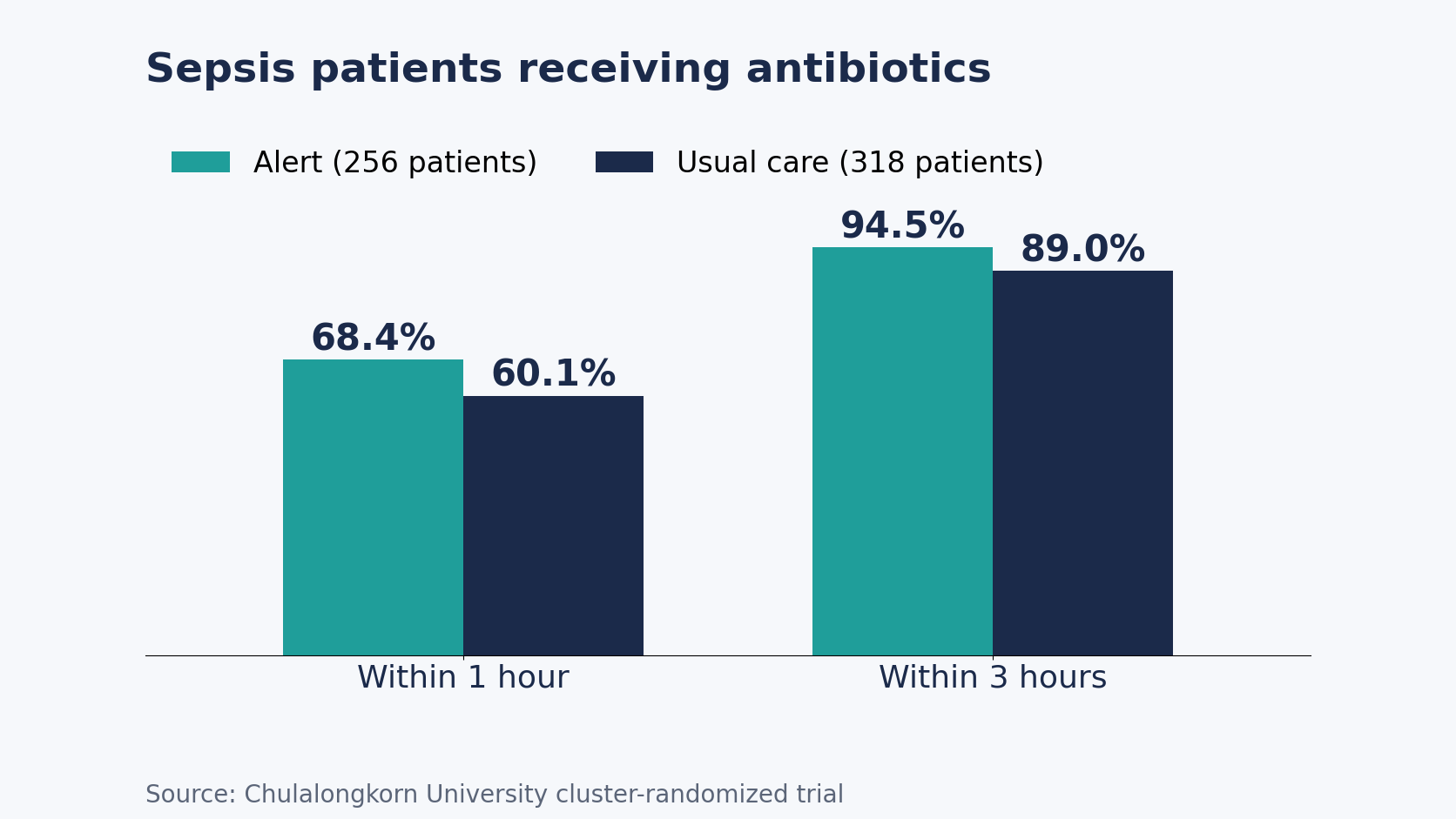
Median time from triage to antibiotics changed less: 46 minutes with the alert, compared with 50 minutes under usual care. These figures describe different aspects of treatment timing. A larger proportion met the one-hour target, while the median shifted only four minutes.
For AI in emergency medicine, this is evidence about a treatment process in one hospital. The findings alone cannot establish a survival benefit across other care settings. Before adoption, another department should check alert volume, staff response, and antibiotic use in patients without infection. Earlier treatment must remain clinically appropriate.
ECG Alerts: Identifying High-Risk Patients beyond the Presenting Complaint
Chin-Sheng Lin and colleagues [2] studied an AI-enabled electrocardiogram alert in a multisite randomized trial in Taiwan. The study involved 39 physicians and 15,965 patients. It included emergency and inpatient care, so its overall results should not become an emergency-only mortality estimate.
The artificial intelligence system produced a report and warned physicians about patients with a high predicted risk of death. Within 90 days, mortality was 3.6% in the intervention group and 4.3% in the control group. The hazard ratio was 0.83, with a 95% confidence interval of 0.70 to 0.99.
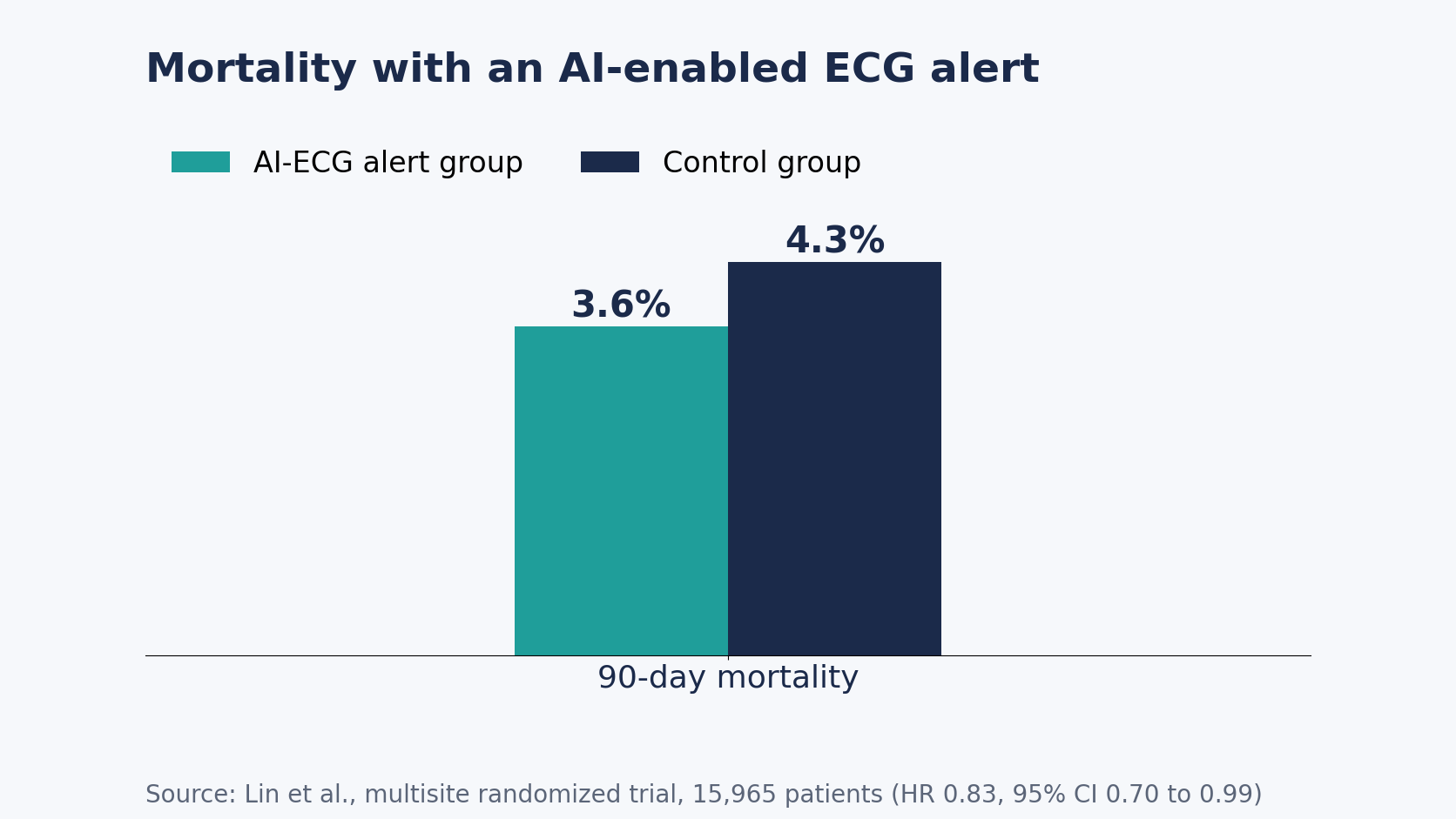
The absolute difference was 0.7 percentage points. The hazard ratio describes the relative hazard over follow-up; it does not mean a 17-percentage-point reduction in deaths. Patients with high-risk ECGs in the intervention group also received more intensive care.
This trial tested an alert plus a clinical response, rather than a score in isolation. However, the authors could not fully explain the pathway that produced the mortality difference. Hospitals need to examine the full response process before transferring the result elsewhere. An alert that reaches an understaffed team may have a different effect.
Machine Learning for Critically Ill Patients: Predicting Next-Day Extubation
Samuel W. Fenske and colleagues [3] developed a machine learning model to anticipate removal of a breathing tube. They used 37 clinical features, including ventilator measurements, laboratory results, and assessments of mental status. Their internal cohort contained 448 patients. An external cohort contained 333 patients from a second hospital within the same health system.
The best-performing deep learning model reached an AUROC of 0.870 in both test cohorts. External validation gave a 95% confidence interval of 0.848 to 0.885. AUROC measures discrimination across possible thresholds. It does not mean 87% of extubation decisions were correct.
More importantly, the model learned next-day extubation status from recorded care. This predictive task differs from establishing the safest removal time for each patient. The authors excluded failed extubations from training and examined those cases separately. Some reasons for failure, such as airway protection problems, were difficult to capture in structured data.
These limits matter for AI in emergency medicine ICU care. For ICU patients, a high score cannot replace a breathing trial or bedside assessment. The study did not test whether model-guided decisions reduced ventilation time, reintubation, or ICU mortality. Its authors called for a prospective randomized comparison with protocol-based practice.
Challenges and Limitations: From Explainable AI to Safe Implementation
Across these examples, AI models require more than a favorable accuracy measure before clinical adoption. Data quality, staffing, and the route from output to action all affect the clinical result.
The DECIDE-AI guideline from Baptiste Vasey and colleagues [4] addresses early clinical evaluations of AI-based decision support systems. It calls for reporting on safety, human factors, and the implementation environment, so readers can judge whether a result could transfer to their own clinical practice.
For AI in emergency medicine, a practical review should cover:
- Local performance: Test current data, missing values, and patient groups separately. Measure calibration, not only discrimination.
- Alert burden: Count false alarms, repeated warnings, and the time each response takes.
- Clinical responsibility: Name the person who reviews the output and the fallback when the tool fails.
- Ongoing monitoring: Track errors, software changes, and changes in the patient population.
Explainable AI can show which inputs influence a prediction, but a feature-importance chart does not prove that those inputs cause the outcome. Our article on clinical validation of AI in healthcare explains how external and prospective testing address different questions.
Regulatory Status: A Separate Check before Implementation
Regulatory status needs a separate check. The US Food and Drug Administration [5] distinguishes software functions according to their intended use. Software that supports time-critical decision-making cannot qualify as non-device clinical decision support under those criteria. Yet software that simply retrieves relevant medical information in an emergency setting may qualify. The location alone does not settle the classification.
A product may fall within software as a medical device, depending on its function. Teams purchasing medical devices should verify their status and permitted use before purchase. In Europe, the European Commission [6] describes the AI Act’s risk-based framework, including human oversight and monitoring for high-risk systems. Procurement teams should check the applicable category and requirements for their product. Legal challenges related to liability and data access also need review before deployment.
Where AI in Emergency Medicine ICU Care Should Go Next
Future research should compare AI-assisted care with the best available usual care, including established treatment protocols. A systematic review can identify evidence gaps, but each proposed use still needs an appropriate clinical study. Studies need to measure harms alongside benefits. Relevant outcomes in emergency care include unnecessary antibiotics and delayed escalation. Studies in acute care settings should also track repeat intubation and staff workload.
Medical informatics teams can also support safer implementation of AI algorithms. They can check whether medical data arrive on time and whether changing documentation alters the output. Integration of AI into emergency workflows should preserve a clear route back to ordinary care during outages. Introducing AI into emergency medicine also needs a named clinical owner.
For hospitals, the next step is a narrow pilot with a prespecified decision and success criteria. Choose one task, define the response, and agree on stopping rules. That approach gives teams a fair test of AI tools under their own conditions. Improving patient care should remain the endpoint for AI solutions, alongside safety and acceptable workload.
Discuss Your AI in Emergency Medicine ICU Project with Neural Board
At Neural Board, we help healthcare teams assess AI in emergency medicine ICU care, connecting medical research with practical evaluation plans. We can review a proposed tool, its study design, and the outcomes that matter for your service. Contact us to discuss an evaluation before you commit to implementation.
References
- Kijpaisalratana, Norawit, et al. “Real-time machine learning-assisted sepsis alert enhances the timeliness of antibiotic administration and diagnostic accuracy in emergency department patients with sepsis: a cluster-randomized trial.” Internal and Emergency Medicine, vol. 19, 2024, pp. 1415-1424. https://doi.org/10.1007/s11739-024-03535-5.
- Lin, Chin-Sheng, et al. “AI-enabled electrocardiography alert intervention and all-cause mortality: a pragmatic randomized clinical trial.” Nature Medicine, vol. 30, no. 5, 2024, pp. 1461-1470. https://www.nature.com/articles/s41591-024-02961-4.
- Fenske, Samuel W., et al. “Developing and validating machine learning models to predict next-day extubation.” Scientific Reports, vol. 15, 2025, article 27552. https://doi.org/10.1038/s41598-025-12264-4.
- Vasey, Baptiste, et al. “Reporting guideline for the early-stage clinical evaluation of decision support systems driven by artificial intelligence: DECIDE-AI.” Nature Medicine, vol. 28, no. 5, 2022, pp. 924-933. https://www.nature.com/articles/s41591-022-01772-9.
- US Food and Drug Administration. “Clinical Decision Support Software Frequently Asked Questions (FAQs).” FDA, https://www.fda.gov/medical-devices/software-medical-device-samd/clinical-decision-support-software-frequently-asked-questions-faqs. Accessed 13 Nov. 2026.
- European Commission. “AI Act.” Shaping Europe’s Digital Future, https://digital-strategy.ec.europa.eu/en/policies/regulatory-framework-ai. Accessed 13 Nov. 2026.