

Missing data in clinical trials can change conclusions about benefits and harms. A missed visit may reflect recovery, worsening symptoms, or practical barriers. Each explanation raises different concerns. This guide explains the main assumptions, compares published examples, and shows why prevention and sensitivity checks belong in every study team’s plan.
What Causes Missing Data in Clinical Research?
A missing value creates a problem when the intended measurement remains relevant to the research question. However, the reason for its absence matters as much as the number of empty cells.
Rombach and colleagues [1] describe three types of missing data:
- Missing completely at random: missingness depends on neither recorded information nor the unrecorded values.
- Missing at random (MAR): recorded information explains differences in missingness; the unrecorded values add no further explanation.
- Missing not at random (MNAR): missingness still depends on unrecorded values after accounting for recorded information.
Suppose patients with worse recorded baseline pain miss more appointments. The assumption that data are missing at random may be reasonable after accounting for baseline pain. However, unrecorded worsening could make that assumption unreliable. Researchers cannot distinguish MAR from MNAR using observed data alone.
A low percentage of missing measurements offers no automatic protection against bias. Also, complete-case analysis removes records with missing analysis variables. Those participants may differ from those who remain. The approach can still be valid under suitable assumptions, but researchers must explain them.
Why Missing Data in Clinical Trials Need a Planned Response
The National Research Council [2] prioritizes prevention because every analytical remedy requires assumptions. Meanwhile, Food and Drug Administration guidance [3] connects the research question with plans for treatment changes and follow-up. The following studies show how decisions about models, supporting measurements, and uncertain assumptions can change what researchers learn afterward.
Compare Multiple Imputation and Mixed Models after Knee Replacement
Rombach and colleagues [1] compared three methods for handling missing data with simulations based on a knee-replacement randomized trial. They used five-year follow-up records from 983 participants with complete measurements to construct realistic missingness scenarios.
The simulations introduced missing patient-reported scores in 10%–60% of participants. Therefore, these percentages describe simulated conditions, rather than the original trial’s overall loss to follow-up.
The team compared multiple imputation, maximum likelihood, and inverse probability weighting across 1,000 repetitions per scenario. Multiple imputation and maximum likelihood performed similarly when imputation used baseline predictors alone. However, multiple imputation performed better when the model included useful measurements recorded after randomization. Weighting performed worse in the scenarios studied.
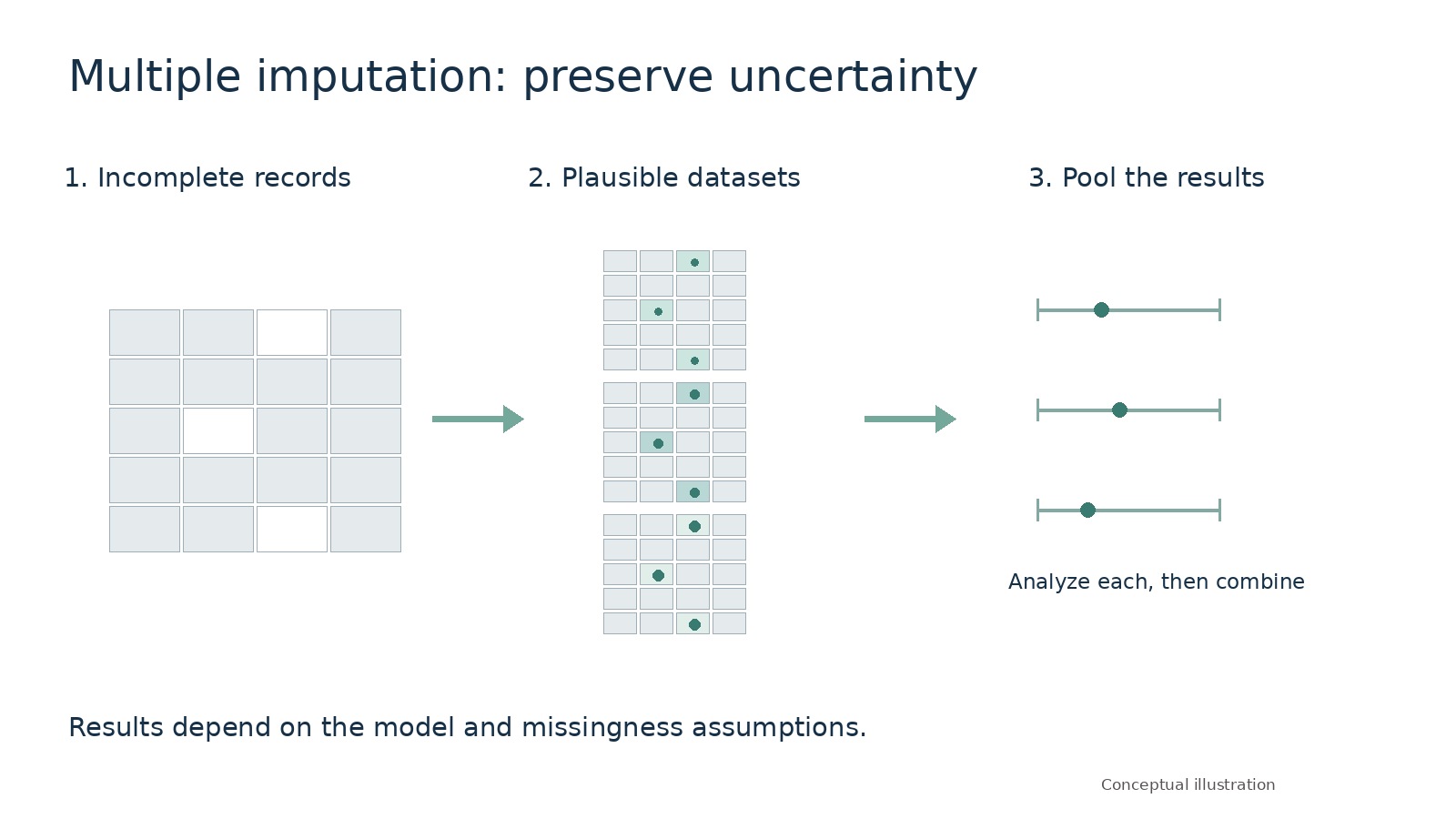
Multiple imputation for missing data creates several plausible completed datasets. Researchers analyze each dataset, then pool estimates and uncertainty. This process includes variation between the imputed datasets in the standard error.
The practical lesson: choose an imputation method that uses relevant information and respects repeated measurements. These results concern longitudinal data under MAR assumptions. They do not establish one universally superior method or validate the same approach when missingness depends on unrecorded outcomes.
Use Supporting Measurements in the DINO Clinical Trial
Sullivan and colleagues [4] examined missing data handling with simulations and a reanalysis of the DINO infant-nutrition trial. Their simplified example assessed fat-free mass at seven years after assignment to high or standard dietary DHA.
Among children included in this example, the measurement was unavailable for 24.8% in one group and 17.8% in the other. The researchers used weight, height, and systolic blood pressure as auxiliary information to help predict missing values.
The adjusted complete case analysis produced an estimated difference of 0.048 kg, with a standard error of 0.238 kg. Imputation separately within each group produced −0.118 kg and 0.227 kg, respectively. Both confidence intervals included zero. Thus, the analysis offered little evidence of a treatment effect on this endpoint.
Precision improved only modestly. Almost half of children without fat-free-mass measurements also lacked all three supporting measurements.
The practical lesson: supporting variables help only when they contain useful information. An imputation regression model cannot manufacture measurements that the study never captured. Moreover, these findings come from a simplified secondary analysis. They do not settle the trial’s broader questions about infant development or justify universal rules for clinical research.
Test Missing Outcome Assumptions in a Pediatric Eczema Clinical Trial
Cro and colleagues [5] demonstrated controlled multiple imputation with the ADAPT trial in children with severe eczema. The study assigned 30 children to omalizumab and 32 to placebo for 24 weeks.
Only two children, both receiving placebo, lacked week-24 quality-of-life scores. However, 11 received rescue medication. These are distinct issues: an uncollected measurement differs from an outcome following a treatment change.
The authors examined a hypothetical question: what would quality of life have been without rescue medication or treatment withdrawal? Their analysis treated measurements after those events as unavailable for that question, even when researchers had collected them.
They used delta-adjusted multiple imputation to explore worse unobserved responses than MAR predicted. Delta shifts the assumed average response. Researchers can vary that shift across clinically plausible scenarios and compare the resulting estimates.
The practical lesson: sensitivity analyses must match the research question. Multiple imputation alone does not remove bias from missing outcome data. Also, the recorded percentage of missing measurements may not describe the uncertainty in a hypothetical analysis.
Clinical input should guide the size and direction of the adjustment. Neither the model nor the observed responses can establish what those children would have experienced without treatment changes.
Better Trial Design Starts before the First Missed Visit
The next improvement in missing data in clinical trials should start with better planning. More elaborate software cannot replace follow-up or establish the correct assumption about absent measurements.
The National Research Council [2] recommends efforts to prevent missing data throughout trial conduct. For treatment-policy questions, teams should seek relevant follow-up after discontinuation of treatment, when consent permits. Stopping study treatment does not automatically end participation.
Before recruitment, specify the approach to missing data in the statistical analysis plan. Include:
- Practical data collection arrangements and reasons for missing data.
- The primary model, its assumptions, and planned sensitivity analyses.
- Data management checks and useful supporting variables.
- How teams will report missing data across groups and visits.
Use healthcare data visualization to inspect those patterns, without treating a chart as proof of MAR.
Also, scrutinize simple imputation methods. For unrecorded outcomes, mean imputation and last observation carried forward can distort uncertainty or impose implausible assumptions. The Council cautions against single imputation as a primary strategy without scientific justification. A defensible treatment of missing data requires a clear question, suitable methods, and transparent limitations.
Contact Us about Reliable Clinical Trial Analyses
Handling missing data in clinical trials requires choices that fit the study question, follow-up patterns, and intended use of results. We help research teams review analysis plans and assess the evidence behind their conclusions. Contact us to discuss your study, its missing measurements, and the decisions that need independent review.
References
- Rombach, Ines, et al. “Comparison of Statistical Approaches for Analyzing Incomplete Longitudinal Patient-Reported Outcome Data in Randomized Controlled Trials.” Patient Related Outcome Measures, vol. 9, 2018, pp. 197–209. https://doi.org/10.2147/PROM.S147790.
- National Research Council. The Prevention and Treatment of Missing Data in Clinical Trials. National Academies Press, 2010. Chapter 6, “Conclusions and Recommendations.” https://www.ncbi.nlm.nih.gov/books/NBK209905/.
- U.S. Food and Drug Administration. E9(R1) Statistical Principles for Clinical Trials: Addendum: Estimands and Sensitivity Analysis in Clinical Trials. Guidance for Industry. May 2021. https://www.fda.gov/media/148473/download.
- Sullivan, Thomas R., et al. “Should Multiple Imputation Be the Method of Choice for Handling Missing Data in Randomized Trials?” Statistical Methods in Medical Research, vol. 27, no. 9, 2018, pp. 2610–26. https://doi.org/10.1177/0962280216683570.
- Cro, Suzie, et al. “Sensitivity Analysis for Clinical Trials with Missing Continuous Outcome Data Using Controlled Multiple Imputation: A Practical Guide.” Statistics in Medicine, vol. 39, no. 21, 2020, pp. 2815–42. https://doi.org/10.1002/sim.8569.