
AI now sits beside diagnosis, triage, and documentation in daily care. Yet vendor claims about large language models in clinical medicine often outpace the evidence. This review shows what the benchmarks actually measured and why sober model performance data beats marketing. Read on for the tasks, the numbers, and the caveats.
What This Systematic Review of Clinical Reasoning Actually Measures
Method sets the standard, so start there. A systematic review follows a fixed protocol. It defines the question, the databases, and the inclusion rules before any search begins. A scoping review maps a broad field more loosely. A narrative review skips the protocol.
| Review type | What it does | Rigor |
| Systematic review | Protocol-driven search and screening | High |
| Scoping review | Maps the breadth of a field | Medium |
| Narrative review | Expert summary, no set protocol | Low |
This review of published studies leans on the stricter end. Shool et al. screened work under PRISMA – the Preferred Reporting Items for Systematic Reviews – and kept 761 studies evaluating large language models in clinical medicine. LLMs in medicine draw intense interest, yet LLMs in clinical settings still lack a shared yardstick.
Scoring is the harder part. Strong benchmarks measure output against a known answer. They pair language model performance and clinical reasoning tasks with a gradable target. Exam items, the objective structured clinical format, and curated clinical vignettes all work here. So every clinical task earns a number, not an opinion. Yet studies using large language models rarely align on scoring. Heterogeneity blocked any pooled estimate. Therefore weigh single accuracy figures for AI in clinical medicine with care.
Why LLM Clinical Reasoning Matters Right Now
Fluent text is easy; sound reasoning is not. AI now assists at the point of care. In real-world clinical settings, that gap decides whether large language models in clinical medicine help or harm at the bedside. The three tasks below each map to a measurable target.
Ranking Differential Diagnoses From Case Presentations
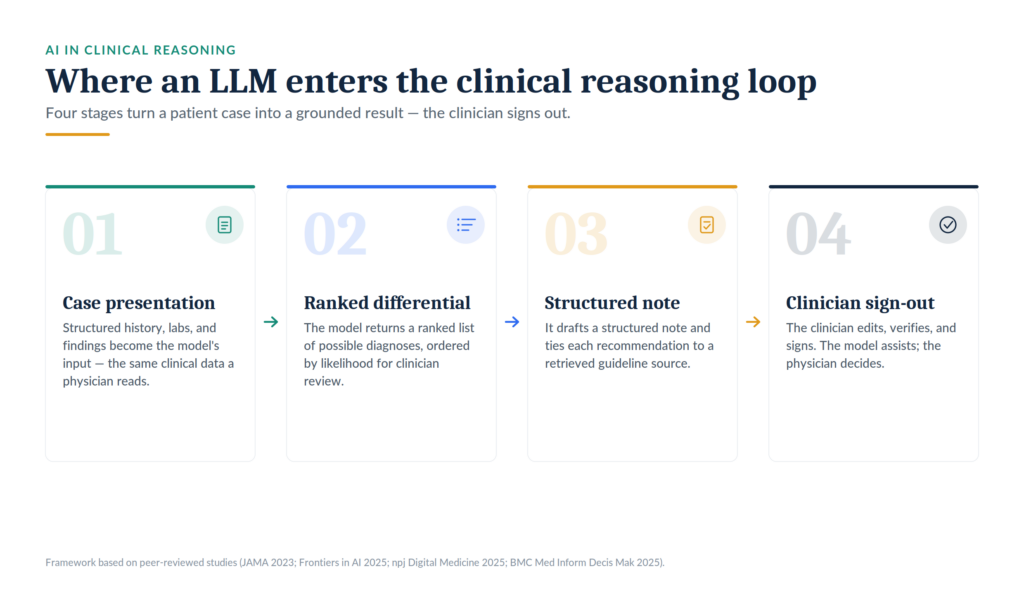
Feed the model a case presentation. Ask for a ranked differential. That is the whole task.
Kanjee et al. tested GPT-4 on 70 New England Journal of Medicine clinicopathological cases [1]. These are hard, real clinical puzzles. The correct diagnosis appeared in the model’s differential in 64% of cases (45 of 70). It topped the list in only 39% (27 of 70). The models were given the case text and clinical data, nothing more.
Context reframes that score. On short, common clinical vignettes, a generative artificial intelligence model can pass 80% list accuracy. Complex cases pull it down, and rare presentations are where the misses cluster.
One figure hides the real risk. A single accuracy number says nothing about calibration. This large language model chatbot sounds equally sure when right and when wrong. So these reasoning tasks need graded rubrics, not a bare hit rate. To evaluate clinical cases, graders score each step. Benchmarks built on medical licensing questions reward recall, the same items a medical student drills. Case-conference sets probe clinical reasoning capabilities and clinical knowledge instead. Newer models narrow the gap; the latest GPT models still miscalibrate. For triage support, that gap drives real clinical impact.
Turning Patient Encounters Into Structured Clinical Notes
An ambient tool listens to a visit. It drafts a structured note. The clinician then edits and signs.
The model does more than transcribe. It infers structure, splits history from plan, and maps speech into clinical notes. Natural language processing handles the words; reasoning handles the shape. This is biomedical natural language processing with a clinical target.
Palm et al. compared AI drafts against physician-written “gold” notes across 97 encounters and five specialties, scored on the PDQI-9 instrument [2]. Physician notes scored 4.25 of 5; AI drafts scored 4.20 – nearly level. Yet hallucinations appeared in 31% of AI notes versus 20% of gold notes. Reviewers still preferred the AI draft, 47% to 39%.
Reducing the documentation burden is the clearest early win. Clinicians lose hours to the electronic health record each day. A clean first draft returns that time to patient care. Even so, the edit step stays mandatory. Reviewers measure draft quality against those clinician edits, because current models still omit and invent.
Retrieving Guidelines to Ground Treatment Recommendations
Off-the-shelf large language models write fluent recommendations. These AI systems also invent them. Retrieval-augmented generation fixes part of that. The model retrieves the relevant clinical information first, then answers from it.
Wada et al. built a local, retrieval-augmented model for radiology contrast media questions [3]. They tested it on 100 synthetic clinical scenarios. Grounded in guideline text for the clinical context, the model showed zero hallucinations, against 8% for the same base model without retrieval. It also outranked three cloud models and replied faster. Because the cases were simulated, no institutional review board approval applied.
The lesson is faithfulness, not fluency. Free generation rewards plausible text. Grounded generation ties each claim to a source, so a reviewer can check it. Even frontier models fabricate without grounding. Pre-trained models carry stale guidance; retrieval refreshes it. Grounded models showed fewer fabrications overall. That difference makes large language models in clinical decision support auditable. Retrieval also helps support clinical decision-making without hiding its sources. For clinical deployment, a traceable answer beats a confident guess. This is where language models using retrieval earn their place in digital health.
Where LLM Clinical Reasoning Goes Next
The next tests are already forming. LLMs in clinical medicine now face live cases. Static leaderboards reward memorized answers; live cases do not.
Expect four shifts:
- Multimodal inputs. AI will read images, labs, and notes together, not text alone.
- Agentic tool use. Large language model-based systems will call calculators, guidelines, and the record, then explain each step.
- Prospective trials. A randomized clinical trial on real-world clinical data will replace static leaderboards.
- Regulation. Clinical use will demand validation, monitoring, and clear accountability.
As LLM applications spread, the risk multiplies too. New clinical applications arrive monthly. Leaderboard wins say little about the performance of these models on tomorrow’s patients. So the field is turning to outcomes – does a tool move clinical outcomes, not just test scores? Prospective clinical research now matters more than another leaderboard. Reasoning-optimized models help here. Models optimized for step-by-step reasoning show stronger transfer. Still, these reasoning models need oversight. For LLMs in medicine, durable performance on live cases is the real target. Independently evaluated models tell you how these models perform on local data. An LLM earns trust on live cases, not leaderboards. The open question is how LLMs in real-world clinical use behave over months, not minutes. Clinical utility depends on that oversight, not on leaderboard rank. That is where leveraging large language models in healthcare becomes safe and useful, across varied clinical environments and everyday clinical practice.
Bring Validated AI Into Your Clinical Workflow
Evidence is the start; integration is the work. We help clinical directors, biotech founders, and health-tech teams choose, validate, and embed large language models in clinical medicine – real AI, not vendor promises – into your biomedical and biotech projects, one workflow at a time, with independent performance checks on your own data. Safe use of large language models starts with evidence. Want to test a use case? Contact us to scope the first pilot.
References
- Kanjee, Zahir, Byron Crowe, and Adam Rodman. “Accuracy of a generative artificial intelligence model in a complex diagnostic challenge.” Jama 330.1 (2023): 78-80.
- Palm, Erin, et al. “Assessing the quality of AI-generated clinical notes: validated evaluation of a large language model ambient scribe.” Frontiers in artificial intelligence 8 (2025): 1691499.
- Wada, Akihiko, et al. “Retrieval-augmented generation elevates local LLM quality in radiology contrast media consultation.” NPJ Digital Medicine 8.1 (2025): 395.