
Sensors have shrunk. Machine learning has matured. Together they power AI wearable health monitoring devices that track your body around the clock. The hardware captures raw signals. The AI layer gives those signals meaning. That shift moves wearables from step counters to clinical instruments, and it is reshaping continuous health monitoring.
How AI Turns Wearable Sensor Data Into Health Insights
Every wearable starts with a sensor. An optical sensor reads blood flow. An accelerometer tracks motion. A pulse oximeter measures oxygen. On their own, these produce a flood of raw numbers.
The data collected by wearable devices means little until software interprets it. That job falls to AI algorithms trained on millions of labeled examples. The model learns which patterns signal a problem and which reflect normal variation. This is where wearable AI earns its keep.
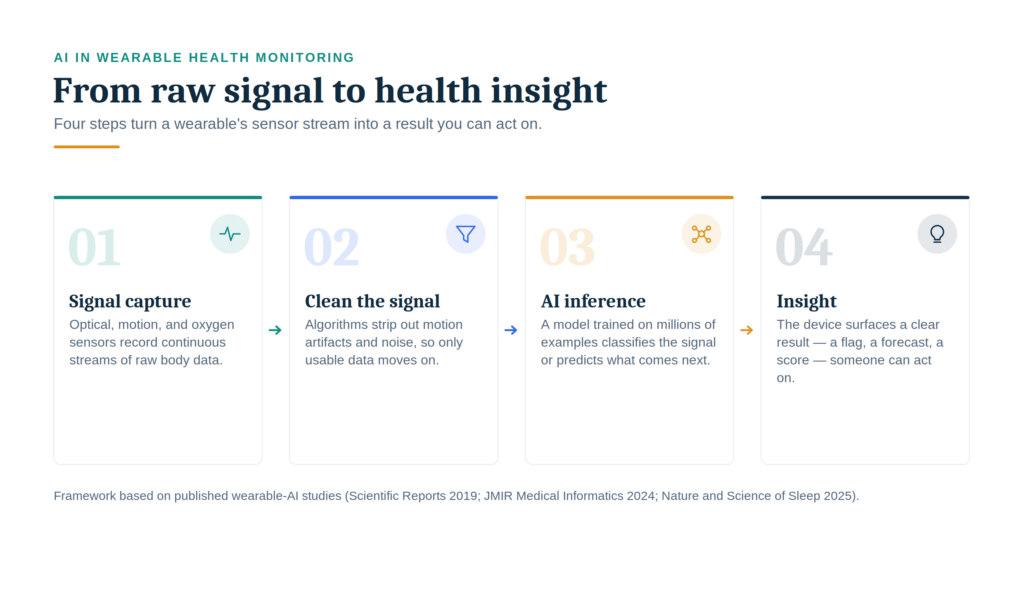
A typical pipeline behind AI wearable health monitoring devices runs like this:
- Signal capture – smart wearable sensors record continuous streams of health data.
- Cleaning – algorithms strip out motion artifacts and noise.
- Inference – the model classifies the signal or predicts a future event.
- Insight – the device surfaces health metrics a person can act on.
Two identical sensors can perform very differently. The gap comes from the model rather than the metal. Strong AI in wearable systems turns messy real-time health data into results that hold up in clinical settings. Weak models flood users with false alarms. So the algorithm decides whether wearable sensors for health monitoring earn a place in care, and whether the emergence of AI-based wearable sensors contributes to improving health outcomes.
Why AI Wearables Matter for Clinicians and Patients Now
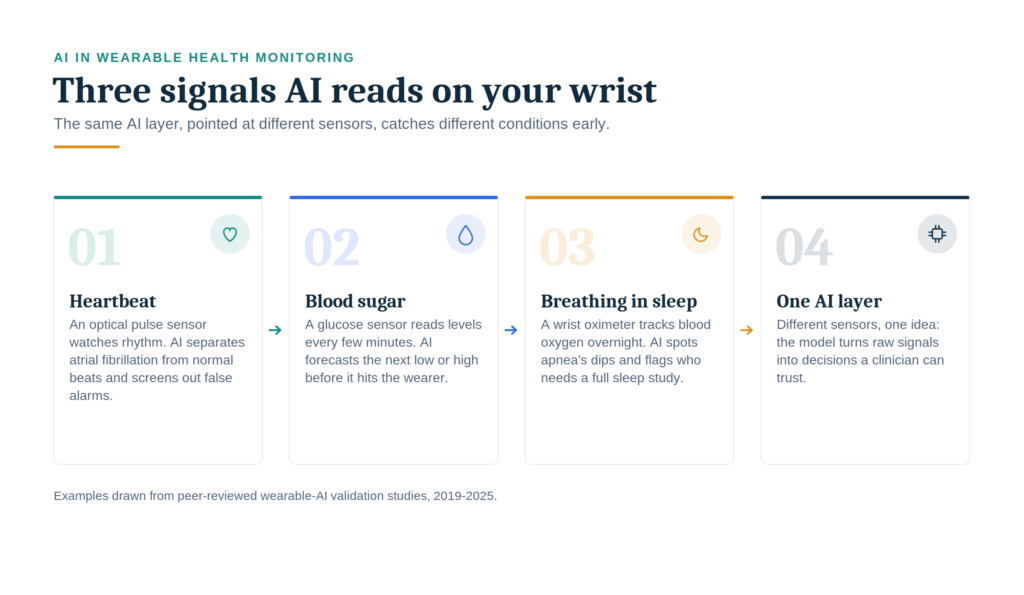
Traditional care captures health in snapshots. One annual physical. One blood draw. AI wearable health monitoring devices replace those gaps with continuous monitoring across weeks and months. That longer view helps healthcare providers catch health conditions early, enable remote patient monitoring, help people track health metrics, and push medicine toward proactive health management. Devices like smartwatches and glucose sensors already prove what AI and wearables can do together. The three examples below show it in practice.
Detecting Atrial Fibrillation from the Wrist with PPG and AI
Atrial fibrillation (AF) affects about 34 million people worldwide and raises stroke risk four to five times. It often stays silent, so many people never know they have it. A smartwatch on the wrist can change that.
Researchers at the University of Connecticut tested this approach in a study published in Scientific Reports [1]. Their wearable device used photoplethysmography (PPG) – an optical sensor that reads pulse from blood flow – alongside an accelerometer and an ECG lead. The AI method flagged irregular rhythm from the pulse signal, then screened out premature beats that mimic AF.
Across two datasets, the algorithm reached:
- 98.18% sensitivity – correctly catching true AF episodes.
- 97.43% specificity – correctly clearing normal rhythm.
- 97.54% accuracy overall.
One dataset included 37 patients, 10 of them with AF. The team also tackled a real problem: motion and noise wreck PPG signals during daily activity. Their filter discarded corrupted segments first, which cut false alarms sharply.
That last point matters. False AF alerts create anxiety and erode trust. Reliable models keep wearable devices and AI useful for long-term patient monitoring rather than annoying. Early detection here genuinely prevents strokes.
Predicting Hypo- and Hyperglycemia with CGM Sensors and AI
A glucose number tells you where you are now. It says nothing about where you are heading. For people with diabetes, that blind spot can trigger a dangerous low. AI closes it.
Continuous glucose monitors (CGMs) sit under the skin and read interstitial glucose every few minutes. On their own, they report the present. Paired with AI, they predict health events before they happen. A validation study in JMIR Medical Informatics [2] built a long short-term memory model to forecast hypoglycemia 30 minutes ahead.
The team trained the model on 192 Chinese patients, then tested it on 427 American patients. Results held up across both groups:
- AUC above 97% for mild hypoglycemia in the training population.
- AUC near 95% when applied to a different population.
- 88% specificity at a 90% sensitivity target, which keeps false alarms low.
This kind of AI device shifts diabetes care from reactive to predictive. It warns the wearer before a crash, so they can eat or adjust insulin in time. The same signal drives closed-loop “artificial pancreas” systems, where the CGM, the AI, and an insulin pump work as one. Here the integration of AI moves a wearable sensor from measurement into active health management.
Screening for Sleep Apnea with Wearable Pulse Oximetry and AI
Obstructive sleep apnea (OSA) is common, yet around 80% of cases go undiagnosed. The gold-standard test, an overnight lab sleep study, is costly and slow. A smartwatch can triage who actually needs it.
A real-world validation in Nature and Science of Sleep [3] tested a Galaxy Watch against full polysomnography. The watch used its PPG sensor to track blood oxygen through the night. During apnea events, oxygen drops in a telltale pattern. An FDA-cleared AI algorithm read those desaturations and estimated the apnea-hypopnea index.
For moderate-to-severe OSA, the watch delivered:
- 92.3% sensitivity and 92.6% specificity.
- 92.5% overall accuracy.
- An AUC of 0.96 against AI-scored sleep studies.
The device also tracked closely with expert scoring, at a correlation of 0.88. Only 53 of 90 enrolled participants produced usable data, so this counts as early evidence rather than a settled result. The watch also underestimated mild cases. Still, wearable technology in healthcare can now flag likely OSA at home, and AI can help route serious cases to the lab. That reshapes health monitoring and diagnostics for a chronic condition millions carry unknowingly, and it hands the healthcare industry a cheaper first screen.
The Future of AI in Wearable Health Technology
Current AI wearable health monitoring devices track one or two signals. The next wave will fuse many at once. Cardiac, metabolic, and respiratory data can combine into a comprehensive health profile that older health technologies could not build alone.
Several fronts are moving fast:
- Non-invasive biomarkers – wearable blood pressure monitors without a cuff, plus sweat sensors that read cortisol and hydration.
- Edge AI – models that run on the device itself, so sensitive health information never leaves the wrist.
- Preventive care – early health interventions that treat risk before it becomes disease.
These AI technologies point toward personalized healthcare and personalized health recommendations tuned to each person’s baseline. Wider integration of AI in wearable platforms could ease pressure on healthcare systems and improve healthcare delivery. Together, wearable technologies and digital health are quietly revolutionizing healthcare.
Real hurdles remain. Privacy law lags behind the data. Regulatory approval takes years. Models trained on narrow groups can fail on darker skin, as the sleep apnea work showed. Clinical validation must keep pace with marketing claims, so the use of AI stays safe. Wearable devices in healthcare are shifting from simple tracking to real prediction.
Handled well, AI in wearable health technology becomes core infrastructure for the future of healthcare. These devices are transforming how and when we spot disease. The future of wearable health tech depends on getting the science right, and that is where artificial intelligence in healthcare proves its value.
Integrate AI Into Your Wearable Health Product
Adding AI to a wearable is a strategy decision before it is an engineering one. We advise medtech teams on where AI fits, which use cases hold up, and what the regulatory path really demands. Our work covers feasibility reviews, model and data-strategy guidance, vendor and validation assessment, and honest reads on clinical claims. Weighing AI for your wearable or health-monitoring product? Get in touch – we help you scope it right before anyone writes code.
References
- Bashar, Syed Khairul, et al. “Atrial fibrillation detection from wrist photoplethysmography signals using smartwatches.” Scientific reports 9.1 (2019): 15054.
- Shao, Jian, et al. “Generalization of a deep learning model for continuous glucose monitoring–based hypoglycemia prediction: algorithm development and validation study.” JMIR Medical Informatics 12 (2024): e56909.
- Kim, Donghyeok, et al. “AI‑enhanced smartwatch AHI estimation and AI‑scored polysomnography for obstructive sleep apnea: real‑world validation.” Nature and Science of Sleep (2025): 2297-2307.