

Fewer than one in ten people with depression receives adequate treatment worldwide. The rest wait, or never gain access to mental health resources at all. Meanwhile, AI in mental health diagnosis now runs inside working products rather than papers. This article covers three applications of AI, the evidence behind each, and the integration questions that follow.
What AI in Mental Health Care Covers Right Now
The use of AI in mental health care divides into three layers. Applications of artificial intelligence for mental health reach patients, clinicians, and planners at once. Each layer solves a different problem, so blurring them wrecks procurement decisions.
| Layer | What the AI does | Where it sits |
| Clinician-facing | Triage queues, ambient documentation, session-quality scoring | Inside the clinical workflow |
| Patient-facing | Guided CBT chatbots, symptom trackers, mood check-ins | On the patient’s phone |
| Population-level | Risk stratification across electronic health records, escalation prediction | Inside the health system’s data layer |
Each layer carries its own evidence burden. Chatbots for mental health support need trial data on symptom change. Population-level AI models need calibration across every group they score. Vendors often quote evidence from one layer while selling another.
Two things fall outside this article. First, autonomous diagnosis of mental illness: no AI system diagnoses mental health disorders alone. Second, replacement of licensed mental health professionals.
AI technology handles the repeatable parts: intake, scoring, and monitoring. Diagnosing mental health conditions stays a clinical act. Three subsections follow, one per layer: conversational AI models that deliver CBT, voice screening, and passive sensing.
Why Mental Healthcare Needs AI Tools Now
The case rests on arithmetic. A global shortage of mental health professionals leaves a median of 13.5 specialized workers per 100,000 people. Growing demand for mental health treatment meets a workforce that barely grows. Clinician hours form the bottleneck, so AI in mental health diagnosis and triage targets them first.
AI Tools That Deliver Guided CBT Between Appointments
Two products dominate the published record: Woebot and Wysa. Both use AI to deliver cognitive behavioral therapy through text – thought records, mood check-ins, behavioral activation. A patient waiting fourteen days for a follow-up receives no mental health support in that gap.
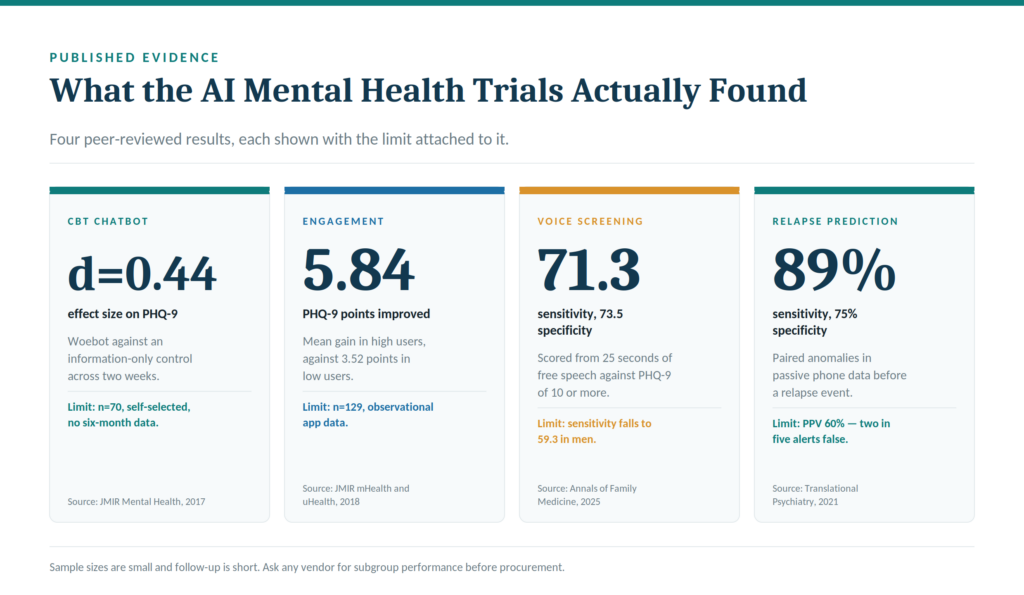
The Woebot trial [1] randomized 70 adults aged 18 to 28. One group used the agent for two weeks; the other received an NIMH ebook. The chatbot group significantly cut Patient Health Questionnaire-9 scores while controls did not. The between-groups effect size reached d=0.44, with roughly 12 check-ins per participant.
The Wysa evaluation [2] analyzed 129 real-world users grouped by engagement. High users (n=108) improved 5.84 PHQ-9 points on average, against 3.52 for low users (n=21).
These AI tools fill a gap; they do not close one. Read the limits as carefully as the results:
Follow-up ran two to three weeks. Evidence on impact on mental health past that window does not exist.
Both samples self-selected. Wysa drew its data from voluntary installs.
Neither study tested acute risk. AI therapy does not handle mental health crises.
Employees of both companies co-authored the papers.
How Clinicians Use AI to Screen for Depression Through Voice
Voice biomarkers attack the same problem differently. Kintsugi and Ellipsis Health sell APIs that score short speech samples. The model uses AI to analyze prosody, pause length, pitch variability, and cadence. It reads the acoustic signature of depression, not the words spoken.
The largest evaluation appeared in Annals of Family Medicine in 2025 [3]. Researchers gathered 25 seconds or more of free speech from 14,898 adults across the US and Canada. They split it into 10,442 training and 4,456 validation samples, then compared output against self-reported PHQ-9 at a cutoff of 10. The authors frame universal screening as an unmet public health need.
| Metric | Result (95% CI) |
| Sensitivity | 71.3 (69.0–73.5) |
| Specificity | 73.5 (71.5–75.5) |
| Positive predictive value | 69.3 (67.1–71.5) |
| Negative predictive value | 75.3 (73.3–77.2) |
Those figures sit inside the 60–90 range typical of screening inventories for any mental health condition. Limited access to care, not accuracy, is the problem solved here. A telehealth call center screens every caller; most primary care encounters screen nobody. Making mental health care more accessible is a question of scale. AI to help clinicians screen differs from AI that diagnoses.
Subgroup performance is where AI in mental health diagnosis gets uncomfortable. Sensitivity fell to 59.3 for men against 74.0 for women, and to 63.4 past age 60. The training sample was 69% female. Accent, language, and hardware add drift. Demand subgroup breakdowns before signing.
Passive Phone Sensing and the Potential of AI to Predict Relapse
Digital phenotyping pushes remote mental health monitoring further. People with mental health conditions carry phones, and phones log location, movement, calls, texts, and screen state. AI systems compare each stream against a personal baseline, then flag anomalies that precede relapse. Here AI in mental health diagnosis turns into forecasting the early signs of mental health decline.
A Translational Psychiatry [4] study tracked 90 participants over three to twelve months. Sixty-three were individuals with mental health conditions on the schizophrenia spectrum. The apps mindLAMP and Beiwe collected GPS, accelerometer, call and text logs, screen time, sleep, plus PHQ-9 and GAD-7 responses. When two feature groups turned anomalous on the same day, the method hit 89% sensitivity and 75% specificity. An earlier pilot found anomalies running 71% above baseline in the two weeks before relapse, so AI can predict escalation early enough to act.
Now the objection. Positive predictive value reached 60%, so two of five alerts were false. Monitoring powered by AI also raises consent questions no chatbot raises. Settle these before any pilot:
Who sees raw location data, and for how long?
What happens when a patient withdraws consent mid-episode?
Who acts when an alert fires?
Does the model run on-device or in a vendor cloud?
Where the Future of AI in Mental Health Care Is Heading
Three developments already sit in trials, so the five-year view is not speculative.
Multimodal models. Voice, text, and sensor streams run separately today. Fusing them gives one risk picture per patient. AI capabilities of that kind sharpen identification of mental health risks between visits.
Continuous measurement. Services score symptoms at appointments now. Signals from phones and electronic health records change what a review appointment is for, and AI can provide that continuity.
Regulation. The FDA’s Digital Health Advisory Committee met in November 2025 on generative AI mental health devices. Members raised bias, hallucination, and sycophancy, then pressed for human escalation during a crisis.
Reimbursement decides adoption faster than accuracy does. CMS now pays for digital mental health treatment devices, so AI for mental health has a US billing route that did not exist three years ago. Payer coverage elsewhere stays patchy.
One constraint shapes the rest. The future of mental health care depends on validation in the populations these tools serve. Buyers judge AI in mental health diagnosis on subgroup evidence, and its role in mental health teams stays supportive. Responsible AI means publishing subgroup performance before a regulator finds it.
Integrate AI Into Your Mental Health Service
Most failed deployments begin with a product demo instead of a workflow audit. Reverse it, and scope AI use to one workflow. Find where screening consumes clinician hours, then check vendor trials for subgroup performance. If you build AI for mental healthcare, that sequence produces your validation evidence.
Book a consultation to map your first pilot.
References
Fitzpatrick, Kathleen Kara, Alison Darcy, and Molly Vierhile. “Delivering cognitive behavior therapy to young adults with symptoms of depression and anxiety using a fully automated conversational agent (Woebot): a randomized controlled trial.” JMIR mental health 4.2 (2017): e7785.
Inkster, Becky, Shubhankar Sarda, and Vinod Subramanian. “An empathy-driven, conversational artificial intelligence agent (Wysa) for digital mental well-being: real-world data evaluation mixed-methods study.” JMIR mHealth and uHealth 6.11 (2018): e12106.
Mazur, Alexa, et al. “Evaluation of an AI-based voice biomarker tool to detect signals consistent with moderate to severe depression.” The Annals of Family Medicine 23.1 (2025): 60-65.
Henson, Philip, et al. “Anomaly detection to predict relapse risk in schizophrenia.” Translational psychiatry 11.1 (2021): 28.