
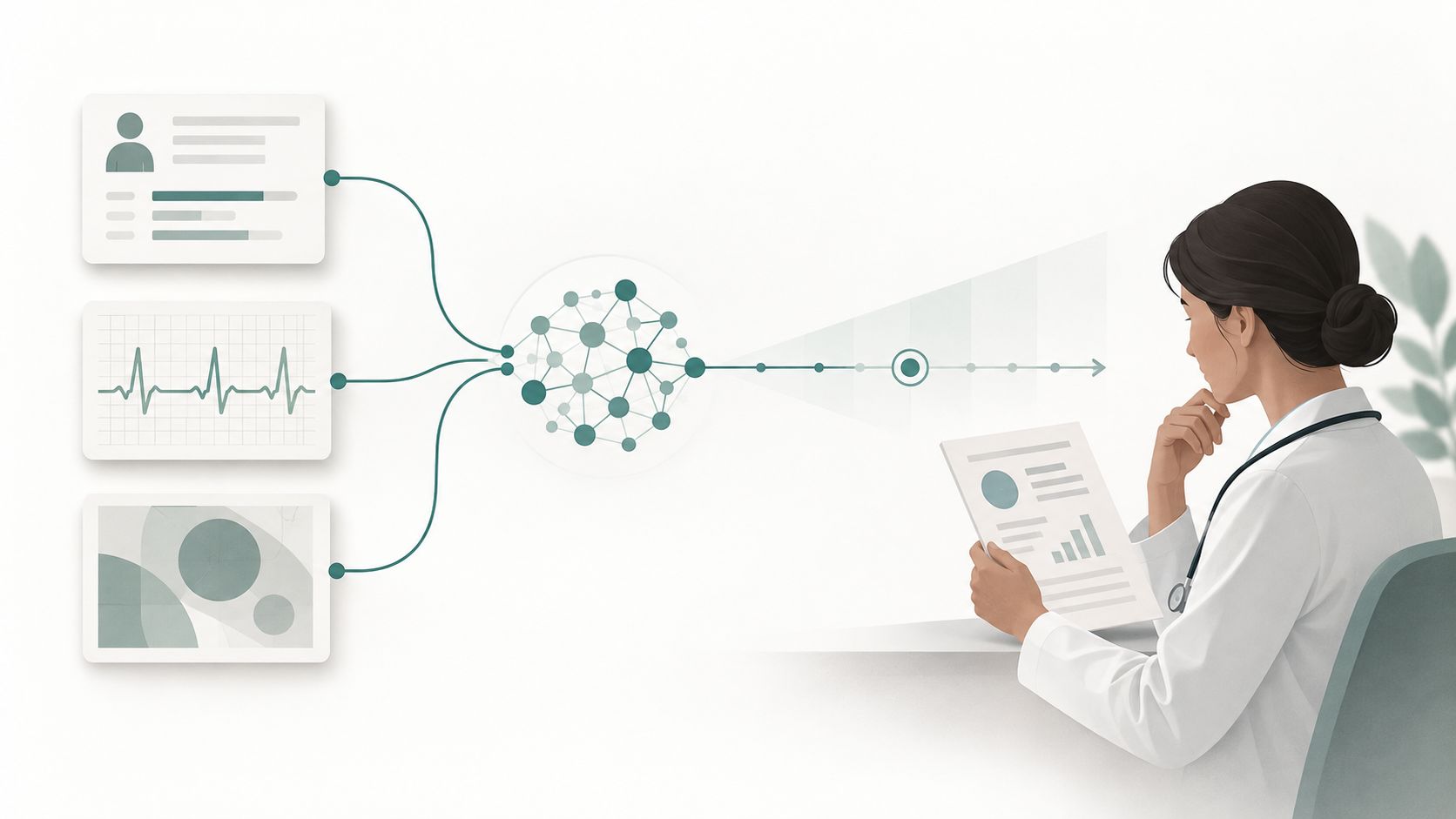
Can AI predict health problems before symptoms? Research on diabetes, heart dysfunction, and breast cancer offers specific examples. The role of AI in early detection and disease prevention depends on the next clinical step. A risk estimate expresses probability. A positive result still requires appropriate assessment before decisions about care.
How Artificial Intelligence Turns Health Data Into Risk Estimates
Medical records contain more than isolated test results. They also capture health history, treatment patterns, and changes over time. Machine learning can connect these observations with outcomes recorded later.
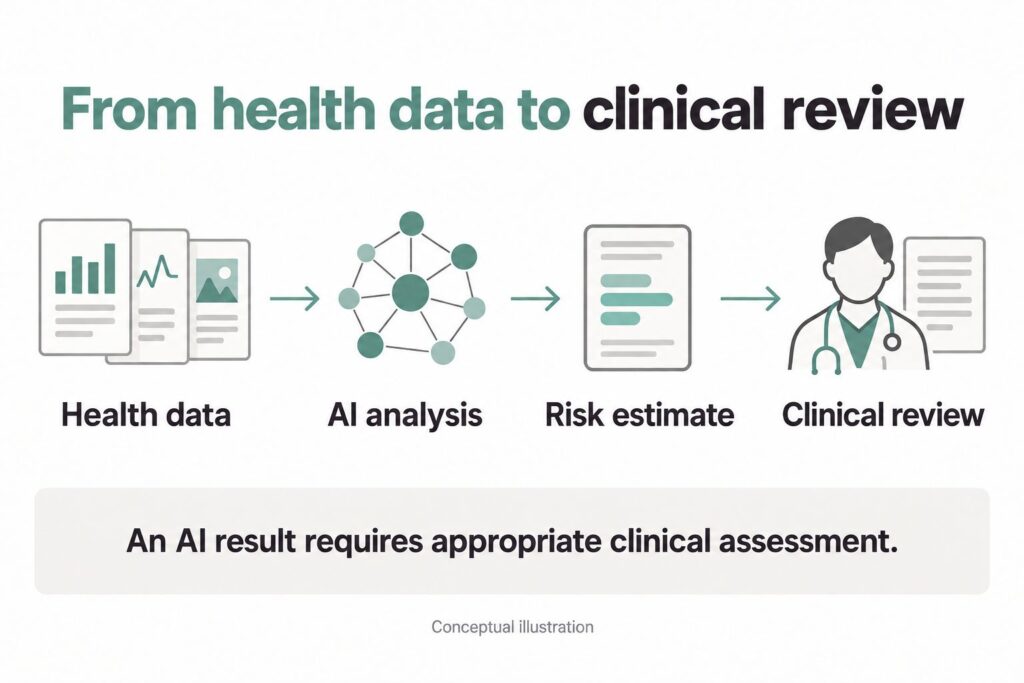
During development, researchers give model examples with known outcomes. Next, they test its performance on separate data. This checks whether the model can recognize useful patterns beyond its training data.
AI algorithms can analyze large datasets, but each model answers a defined question. Future risk and existing disease require different interpretations. A forecast estimates the chance of a later event. Screening seeks signs of a condition that may already exist. Neither output automatically establishes a disease diagnosis.
Can AI predict health problems before symptoms? The answer therefore depends on the data, target condition, and time horizon.
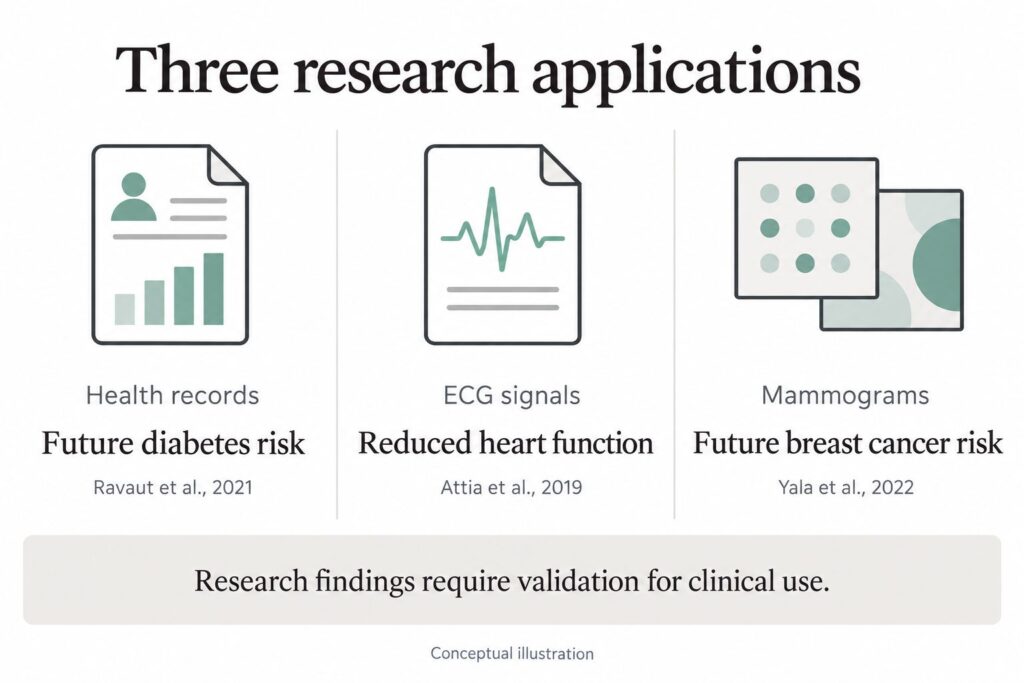
The studies below use three different inputs:
- Administrative records support population-level planning for a chronic condition.
- ECG signals can flag reduced heart pumping function for further assessment.
- Mammograms can estimate future breast cancer risk and inform research on screening choices.
Electronic health records offer another source of medical data, although they differ from administrative databases. Each application of AI needs validation for its intended setting. Clinical data quality and follow-up capacity determine whether the use of AI can support patient care.
Earlier Disease Detection Creates Time for Preventive Care
An early warning creates time for confirmatory testing, closer monitoring, or early intervention. However, false positives can trigger unnecessary tests, while missed cases delay assessment. Better predictive performance alone cannot establish better health outcomes. Connecting detection and prevention requires evidence that the response to a warning actually helps patients overall.
Using Health Records to Predict Type 2 Diabetes Five Years Ahead
Ravaut and colleagues studied linked administrative records from approximately 2.1 million Ontario residents [1]. They developed a gradient-boosting model to estimate onset five years ahead.
The inputs covered two years of health history, including laboratory measurements, prescriptions, healthcare visits, and social characteristics. These records captured potential risk factors without requiring a new screening visit. However, they lacked some useful measurements, including body mass index.
The researchers assessed two different properties:
- Discrimination: the model’s test AUC reached 0.8026, indicating its ability to rank future cases above people without the condition.
- Calibration: estimated probabilities generally matched observed rates, although the highest-risk group showed some overestimation.
The intended use was population health planning. The authors explicitly excluded individual treatment decisions from their goal. This example of AI in public health could help a healthcare system identify communities that need prevention resources.
Can AI predict health problems before symptoms? This retrospective study supports forecasting recorded onset, rather than proving a symptom-free interval for every person.
The findings also suggest a route for optimizing resource allocation across chronic diseases. Nevertheless, external and prospective validation would need to establish reliability before deployment. The study did not demonstrate that model-guided prevention improved outcomes or reduced costs in practice.
AI-Enabled ECGs to Flag Reduced Heart Function
Attia and colleagues used AI to examine routine 12-lead ECGs [2]. Their neural network targeted reduced left ventricular pumping function. An ECG records electrical activity; echocardiography measures the pumping function used as the study’s reference.
The team trained the network with paired tests from 44,959 Mayo Clinic patients. A separate test set included 52,870 patients. The target was an ejection fraction of 35% or less.
The reported results included:
- AUC: 0.93.
- Sensitivity: 86.3%, describing detection of patients who met the study’s dysfunction threshold.
- Specificity: 85.7%, describing correct negative results among patients without that dysfunction.
These figures describe a particular study population and threshold. They cannot establish diagnostic accuracy in every cardiovascular disease setting.
A positive screen calls for further assessment. An echocardiogram can assess ventricular function before a clinician determines the appropriate response.
The study also examined future dysfunction among patients without it initially. Those with positive screens had a hazard ratio of 4.1 compared with those with negative screens. That association suggests the network captured signals linked to later deterioration. However, it does not establish when symptoms began or prove benefit from screening.
This distinction separates existing-disease screening from future risk prediction, even when both involve the same ECG.
Mammogram-Based AI to Predict Breast Cancer Risk
Yala and colleagues evaluated Mirai in Journal of Clinical Oncology [3]. The deep learning model estimated breast cancer risk over one to five years from screening mammograms. The analysis covered 128,793 examinations from 62,185 patients across seven hospitals in five countries.
Researchers tested whether this AI technology could identify higher-risk groups across different screening populations. Across sites, concordance indices ranged from 0.75 to 0.84. This measure assesses how well risk rankings agree with the timing of cancer diagnoses.
At Massachusetts General Hospital, one comparison matched the specificity of an established risk-based screening guideline. Mirai identified 39.7% of cancers diagnosed within five years, compared with 22.9% under the existing approach.
These were retrospective comparisons of screening strategies. They suggest potential value for selecting patients for supplemental screening. They do not demonstrate improved survival or justify automatic referrals without clinical review.
Can AI predict health problems before symptoms? Here, the measured outcome was a later cancer diagnosis. The study did not establish symptom timing for every participant.
All images came from Hologic equipment, which limits conclusions about other vendors. Moreover, prospective trials would need to confirm clinical benefit and suitable screening thresholds. This advancement in breast cancer risk assessment still requires evidence connecting model-guided decisions with benefits and harms in care. For a wider view of AI medical imaging, see our analysis of three clinical studies.
What Will Make Predictive AI Useful in Everyday Care?
Can AI predict health problems before symptoms? These studies support specific capabilities, while leaving practical questions about implementation open.
A useful score needs an agreed response. Before integrating AI, healthcare organizations should define the target population, decision, and follow-up pathway. A service must also have the capacity to investigate positive results.
An assessment of the integration of AI should cover:
- External validation: test AI models in the intended population, with local equipment and recording practices.
- Prospective evaluation: assess the effectiveness of AI during real workflows, including missed cases, unnecessary testing, and patient experience.
- Risk thresholds: weigh additional referrals against overlooked disease and available clinical capacity.
- Accountability: name who reviews each warning, contacts the patient, and tracks incomplete follow-up.
- Data privacy: limit access to patient data and define permitted uses, retention, and security responsibilities.
AI systems also need ongoing monitoring as populations, equipment, and clinical practice change. Check performance across patient groups, rather than relying on one overall average. Record both benefits and harms.
The potential of AI in healthcare depends on this connection between evidence and action. Earlier information has limited value if patients cannot access assessment or treatment. Responsible disease prediction therefore requires a workable care pathway, clear ownership, and evidence of benefit for the people it serves.
Discuss AI Integration With Neural Board
Considering AI tools for a specific clinical question? Contact Neural Board to discuss your use case. We can start with your available data, intended users, and the action an estimate would trigger. Together, we can assess fit, validation needs, and workflow requirements before defining the next steps for your organization.
References
- Ravaut, Mathieu, et al. “Development and validation of a machine learning model using administrative health data to predict onset of type 2 diabetes.” JAMA network open 4.5 (2021): e2111315.
- Attia, Zachi I., et al. “Screening for cardiac contractile dysfunction using an artificial intelligence–enabled electrocardiogram.” Nature medicine 25.1 (2019): 70-74.
- Yala, Adam, et al. “Multi-institutional validation of a mammography-based breast cancer risk model.” Journal of Clinical Oncology 40.16 (2022): 1732-1740.