
Doctors using ChatGPT in clinical practice – that already happens daily. The tool shows up in two arenas: real patient care and medical education. This article sorts genuine utility from hype, drawing on artificial intelligence research and what clinicians report firsthand. Our aim stays practical throughout.
What ChatGPT and Artificial Intelligence Actually Do in Clinical Work
ChatGPT is a well-known large language model. It predicts text one word at a time, from patterns in its training data. It reads like a clinician and sounds confident – that fluency is the trap.
Here is what general-purpose tools like ChatGPT are not. They are not cleared diagnostic devices, not validated clinical software, not a substitute for a physician’s sign-out. A model can state a wrong dose in flawless prose. So every output needs a human check before it reaches a patient.
Purpose-built clinical AI differs sharply. Vendors train and validate those systems on medical data, then submit them for regulatory review. A public chatbot skips that. The gap matters for any clinical application, and questions about using ChatGPT in the medical field still outnumber answers.
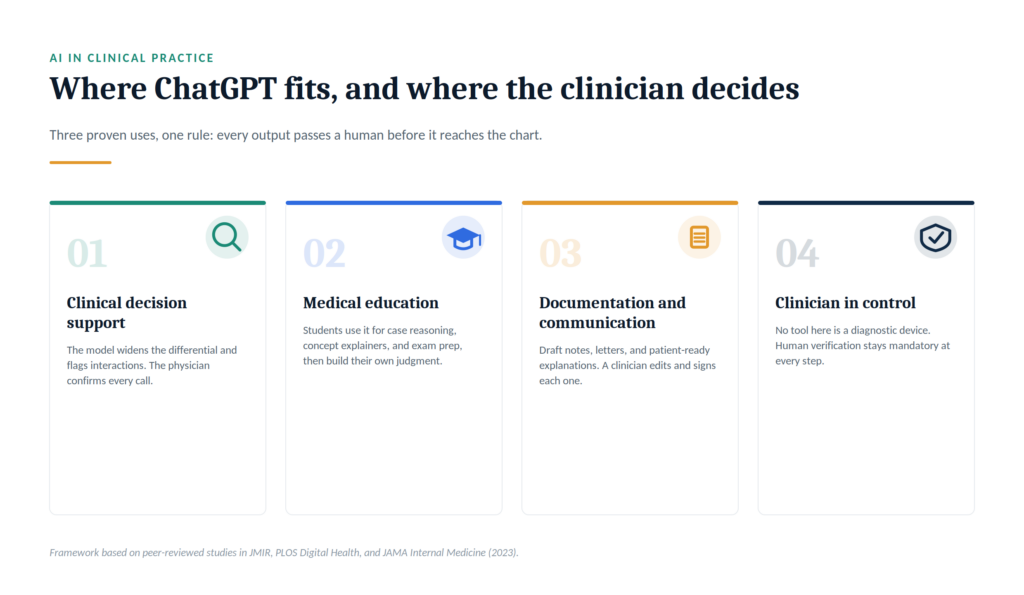
The sensible frame is clinician-in-the-loop. The model drafts; the physician decides. Used that way, tools like ChatGPT in clinical settings support work instead of replacing judgment.
This article covers three core use areas where doctors already reach for the model:
- Clinical decision support – broadening a differential, checking an interaction.
- Medical education – exam prep and on-demand explanation.
- Documentation and patient communication – notes, letters, plain-language answers.
Each section below pairs one real study with the limits attached.
Why ChatGPT in Clinical Practice Matters Now
So where do doctors using ChatGPT in clinical practice actually turn? Three uses dominate right now. The model helps broaden a diagnosis, coaches students through tough concepts, and drafts the documentation that eats clinical time. Each one below pairs a real result with the limits that keep it safe.
Clinical Decision Support and Differential Diagnosis
For doctors using ChatGPT in clinical practice, decision support is the most common entry point. It is often the first real use in clinical settings. A family medicine physician pastes a case. Then they ask the model to widen the differential diagnoses or flag a drug interaction. Applications of ChatGPT for clinical reasoning tend to start right here.
A 2023 study in the Journal of Medical Internet Research [1] tested the real utility of ChatGPT. Researchers ran all 36 clinical vignettes from the MSD Manual through the model, scoring each stage.
| Task | Accuracy |
|---|---|
| Overall | 71.7% |
| Final diagnosis | 76.9% |
| Initial differential diagnosis | 60.3% |
The pattern is telling. Performance of ChatGPT rose as more case details arrived. The accuracy of ChatGPT in providing a final diagnosis reached 76.9%, yet the opening differential came in weakest. That gap matters most for catching a rare diagnosis. Clean textbook vignettes also flatter the model; messy charts and atypical presentations are harder.
So this stays clinical decision support and stops short of clinical decision-making. The model can support clinical decisions, but the physician weighs each one against sound clinical reasoning. A physician’s clinical judgment still rules. ChatGPT may widen the view; the physician still closes it.
ChatGPT in Medical Education and Student Training
Medical students adopted ChatGPT faster than anyone. They use ChatGPT for case-based reasoning, quick explanations, and, above all, exam prep. Attitudes toward ChatGPT in training skew positive.
The landmark result came from a 2023 PLOS Digital Health study [2]. The method: feed 350 of 376 public USMLE questions to the model. This was an early test of using large language models on the United States Medical Licensing Examination. The model scored between 52.4% and 75% across the three exams. That sits near or above the ~60% pass mark, with no medical-specific training. Studies show that ChatGPT holds strong recall of medical knowledge. ChatGPT could clear a licensing exam, yet clearing one still differs from practicing medicine.
Here is the catch for medical education: a tool that explains well can also think for the student. Outsource the reasoning, and the exam score climbs while the clinical thinking does not.
The method is what matters most. Using ChatGPT for medical education works best as a Socratic partner. Ask it to quiz, counter, and explain rather than hand over answers. A student who argues with the model builds judgment; one who copies it borrows a crutch. The habits set in a school of medicine or faculty of medicine show up later at the bedside. There, a borrowed answer and an earned one behave differently under pressure.
Clinical Documentation and Patient Communication
Documentation and patient messaging are where ChatGPT and generative models save the most time. Think discharge summaries, referral letters, and replies that answer medical questions in plain language. The model also restates dense medical information for patients.
A 2023 JAMA Internal Medicine study [3] put this to the test. Evaluators compared physician answers with ChatGPT responses to 195 real patient questions from a public forum. Across 585 blinded ratings, they preferred the chatbot 78.6% of the time. Quality scored 4.13 versus 3.26. Empathy favored the model even more sharply. The result demonstrates that ChatGPT can match, and often beat, rushed human replies on tone.
A separate 2023 perceptions survey found both medical students and graduated doctors positively perceived using ChatGPT for creating patient educational materials. Drafts generated by ChatGPT read as clear and, oddly, warm. That points to value for health care professionals and patients alike.
Two hard limits apply:
- No protected health information goes into a public tool. Ever. Strip identifiers first.
- A clinician reads every draft before it enters the record. Responses from ChatGPT can be fluent and wrong.
Used inside those rails, ChatGPT can help cut the medical documentation load that drives burnout. The model writes the first pass; the physician edits and signs. Medical notes still belong to the human who owns the chart.
Where ChatGPT and Generative AI Are Headed in Healthcare
Today’s workflow is mostly copy-paste. The next phase moves the model inside clinical systems. Four shifts are already underway:
- Ambient scribing – the model drafts the note from the visit audio.
- EHR-embedded assistants – the model reads the chart inside a medical center’s record instead of a pasted snippet.
- Retrieval-grounded answers – the model cites a verifiable source, which blunts current limitations of ChatGPT around fabrication.
- Specialty-tuned systems – using general-purpose LLMs like ChatGPT gives way to models like ChatGPT fine-tuned on focused clinical data.
None of this clears the bar automatically. Any tool that influences care must prove safety on real medical data, then pass regulatory review. Using machine learning in clinical settings earns trust slowly, for good reason.
The honest near-term picture is narrow. The role of ChatGPT stays supportive: draft, summarize, explain, and prompt a second thought. It will not run the clinic. For doctors using ChatGPT in clinical practice, the realistic win is time saved and fewer overlooked options. Autonomy stays off the table.
Use AI where it improves clinical throughput and cuts drudgery. Hold the line everywhere a wrong answer carries real risk. That balance belongs in a budget.
Bringing AI Into Your Clinical Workflow, the Right Way
We advise health systems on where AI in medicine fits – and where it does not. Our scope covers feasibility, defensible use cases, and the governance and privacy gaps that sink rollouts. We assess; we do not build the model. Already have doctors using ChatGPT in clinical practice? Let’s map the safe version. Contact us.
References
- Rao, Arya, et al. “Assessing the utility of ChatGPT throughout the entire clinical workflow: development and usability study.” Journal of Medical Internet Research 25 (2023): e48659.
- Kung, Tiffany H., et al. “Performance of ChatGPT on USMLE: potential for AI-assisted medical education using large language models.” PLoS digital health 2.2 (2023): e0000198.
- Ayers, John W., et al. “Comparing physician and artificial intelligence chatbot responses to patient questions posted to a public social media forum.” JAMA internal medicine 183.6 (2023): 589-596.
- Tangadulrat, Pasin, Supinya Sono, and Boonsin Tangtrakulwanich. “Using ChatGPT for clinical practice and medical education: cross-sectional survey of medical students’ and physicians’ perceptions.” JMIR medical education 9 (2023): e50658.