
The headlines are loud. Can AI diagnose diseases better than doctors? On narrow, well-defined tasks, artificial intelligence sometimes matches or beats clinicians. Yet replacing physicians oversimplifies what the evidence shows. This diagnostic review weighs the real numbers, separates genuine diagnostic accuracy gains from vendor noise, and keeps human expertise in frame.
Inside the Review: How AI Stacks Up Against Human Doctors
A benchmark result needs context before it means anything. In diagnostic studies, three metrics carry the weight:
- Sensitivity – how often a model catches real disease.
- Specificity – how often it correctly clears healthy people.
- AUC – one score summarizing that trade-off across thresholds.
A win on curated images is not readiness for patient care. So this review leans on peer-reviewed work, not marketing decks. Every claim below traces to a published study with extractable numbers.
Across medical applications, the evidence splits into two families. Narrow AI models handle one task – read a retina, flag a lesion, score a mammogram. These AI systems analyze medical images and other clinical data. Trained on vast amounts of medical data, AI algorithms can reach greater accuracy on one call. Generative AI models, by contrast, work with language. Large language tools read medical information and notes across complex medical cases.
Both families can outperform doctors on specific tests. AI could win one test, then miss the next. Neither owns the judgment a clinician brings to a whole patient. No single model dominates the medical domain yet. The real question – can AI diagnose diseases better than doctors – has no one answer.
Why Diagnostic Accuracy Is the Real Test
Missed or delayed diagnosis puts patient health at risk and drives many medical errors. Specialist shortages leave screening gaps open. So, can AI diagnose diseases better than doctors here? On a single task, sometimes yes. AI works best as support that extends human doctors, and three case studies below show where a study finds it earning that role.
Diabetic Retinopathy: Autonomous AI Screening in Primary Care
Diabetic retinopathy is a leading cause of preventable blindness, so early disease detection changes lives. The IDx-DR AI system takes it on directly. It reads retinal photos inside a primary care clinic and returns a result with no eye specialist present.
The pivotal trial [1] enrolled 900 people with diabetes. Against a strict reading-center standard, the system reached:
- 87.2% sensitivity – catching more-than-mild retinopathy.
- 90.7% specificity – correctly clearing healthy retinas.
In 2018, the FDA cleared it as the first autonomous AI in medical diagnostics to make a screening call alone. It needed no physician review. That milestone moves specialty-level diagnostic tools into clinics that lack an ophthalmologist.
The goal is access rather than replacement. The tool flags who needs a specialist; it does not treat anyone. Here AI contributes reach and consistency, while doctors possess the context to act. Faster triage can lead to better outcomes for people who might otherwise skip screening.
Melanoma Detection: Deep Learning vs. Dermatologists
Melanoma is curable when caught early, so accurate reading of skin lesions saves lives. One landmark reader study pitted a Google convolutional neural network against 58 dermatologists from 17 countries.
Researchers trained the model on dermoscopic images, then tested it on a 100-image set [2]. The head-to-head results:
| Metric | AI model | Dermatologists |
|---|---|---|
| ROC AUC | 0.86 | 0.79 |
| Specificity* | 82.5% | 71.3% |
*at the dermatologists’ mean sensitivity of 86.6%.
The model missed fewer melanomas and raised fewer false alarms. On this test set, it beat most participating physicians.
Still, the strengths and limitations deserve equal weight. Experts curated and preselected the images for difficulty. Sets like this underrepresent darker skin tones, which weakens real-world generalization. Clean-benchmark AI performance rarely transfers to a busy clinic. So the honest read stays narrow. On a defined task, AI models can exceed specialists, yet those conditions rarely match daily medical practice.
Breast Cancer Screening: AI in the Mammography Reading Room
Screening programs run on scarce radiologist time. The MASAI trial tested the possibility of AI easing that load safely. This randomized study enrolled 80,033 Swedish women and split them into two arms [3].
One arm used AI-supported reading; the other kept the standard two-radiologist read. Compared to human double reading, the results held up:
- Cancer detection: 6.1 per 1,000 with AI versus 5.1 without.
- False positives: 1.5% in both arms, so no rise in false alarms.
- Workload: a 44% cut in screen-reading effort.
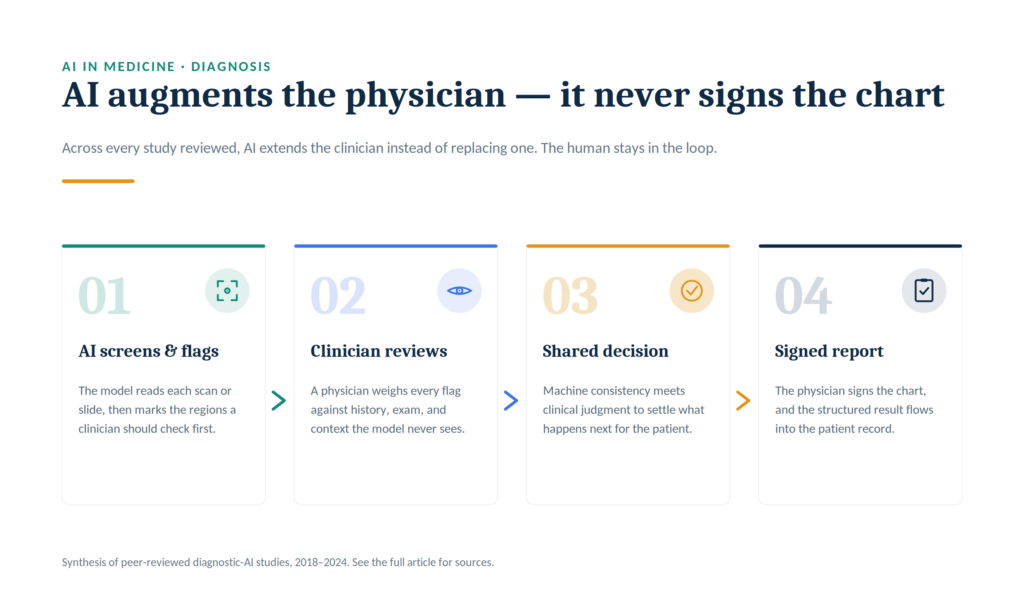
Notably, AI did not empty the reading room. Radiologists kept the final call, while the model triaged and flagged suspicious scans. Teams that use AI as a second reader keep a human in the loop.
The pattern across all three cases stays consistent. AI raises throughput and catches more disease, yet a human signs the report. These AI-driven medical tools help doctors rather than replace doctors, and they can improve patient care. Better patient outcomes here come from pairing machine consistency with clinical judgment. The lesson is augmentation, plainly.
What Comes Next as the AI Research Matures
Artificial intelligence in medicine keeps maturing across diagnoses and treatment. New AI technologies arrive fast. Multimodal medical systems now fuse labs, scans, and medical data at once. Large language tools, the chatbots many clinicians already test, read unstructured text. Trained on medical literature and patient records, they mine electronic health records for health information. They weigh medical history and start suggesting possible diagnoses. On a complex case, they surface a differential fast, even on complex diagnostic problems.
In a randomized trial from Stanford and Beth Israel Deaconess Medical Center, GPT-4 alone outscored physicians on diagnostic reasoning [4]. That is a core part of clinical decision-making. Yet physicians using the same tool barely improved their scores, a sharp lesson for AI adoption. None of this is medical advice a medical professional can sign unchecked.
So, can AI diagnose diseases better than doctors across the board? Pooled evidence says “not quite, not yet.” A landmark [5] found AI roughly on par with human physicians across many health conditions. Only 14 studies compared the performance fairly on the same data. The real test is whether AI generalizes, not whether it wins one benchmark. On new data, AI may slip. AI’s accuracy across specialties, including medical imaging, still varies.
These medical technologies face three gates before integration into clinical practice:
- Prospective validation on real patients and their health data, not retrospective sets.
- Regulation that keeps pace with developing AI.
- Liability when an algorithm errs.
The shift reshapes medical education too, as medical students fold AI into their medical training. One flashy result never moves guidelines. Pooled data and more health research do. The realistic future of medicine favors augmentation. Talk of AI replacing clinicians runs ahead of the data.
Integrate Validated AI Diagnostics Into Your Practice
Ready to bring validated, AI-based medical tools into your service? We help health-tech teams plan the safe integration of AI in healthcare. Still asking can AI diagnose diseases better than doctors in your setting? Contact us and we will scope it together.
References
- Abràmoff, Michael D., et al. “Pivotal trial of an autonomous AI-based diagnostic system for detection of diabetic retinopathy in primary care offices.” NPJ digital medicine 1.1 (2018): 39.
- Haenssle, Holger A., et al. “Man against machine: diagnostic performance of a deep learning convolutional neural network for dermoscopic melanoma recognition in comparison to 58 dermatologists.” Annals of oncology 29.8 (2018): 1836-1842.
- Lång, Kristina, et al. “Artificial intelligence-supported screen reading versus standard double reading in the Mammography Screening with Artificial Intelligence trial (MASAI): a clinical safety analysis of a randomised, controlled, non-inferiority, single-blinded, screening accuracy study.” The Lancet Oncology 24.8 (2023): 936-944.
- Goh, Ethan, et al. “Large language model influence on diagnostic reasoning: a randomized clinical trial.” JAMA network open 7.10 (2024): e2440969.
- Liu, Xiaoxuan, et al. “A comparison of deep learning performance against health-care professionals in detecting diseases from medical imaging: a systematic review and meta-analysis.” The lancet digital health 1.6 (2019): e271-e297.