
The same model that speeds a diagnosis can also invent a finding that was never there. That tension defines the risks of artificial intelligence in medicine. This article speaks to clinical leaders and health-tech founders. We map where AI helps, where it fails, and who answers when the system slips.
AI in Medicine: What This Article Covers
AI in medicine already shapes routine patient care. Scanners flag tumors, chatbots draft notes, and models triage urgent cases. Medical AI spans simple machine learning to generative systems, and each type fails differently. We focus on three settings where the stakes run highest: diagnostic imaging, bedside decision support, and clinician training.
This piece works as a practical decision aid. It serves people who buy, build, or approve these tools. We skip the hype and tie every claim to a peer-reviewed study with real numbers.
Here is the scope:
- In focus: proven applications of AI, measured error rates, and the liability risks behind each use case.
- Left aside: speculative artificial general intelligence and vendor marketing.
We treat both sides honestly. AI tools can lift the quality of care and cut repetitive work. Yet the same ai models carry ethical risks that no board should ignore. Strong governance starts with evidence, so we lead with data on diagnosis and treatment rather than opinion. Clinicians, founders, and health care professionals all need that grounding first.
Why Assessing AI Risk Matters Right Now
Adoption is running ahead of validation and regulation. That gap is where harm hides. The potential benefits are real: faster throughput, steadier reads, and earlier detection. Still, the risks posed run just as real, and the risk of AI grows with autonomy. The three cases below reveal both faces of the risks of artificial intelligence in medicine.
AI in Diagnostic Imaging and Cancer Screening
Breast screening shows the upside in the field, not just the lab. In Germany’s PRAIM study [1], 119 radiologists screened 463,094 women, about 260,000 with AI support. The AI-supported group detected 6.7 cancers per 1,000, a 17.6% lift over the 5.7 rate without AI. Recall stayed noninferior, at 37.4 versus 38.3 per 1,000. So AI can reduce missed cancers without flooding clinics with callbacks.
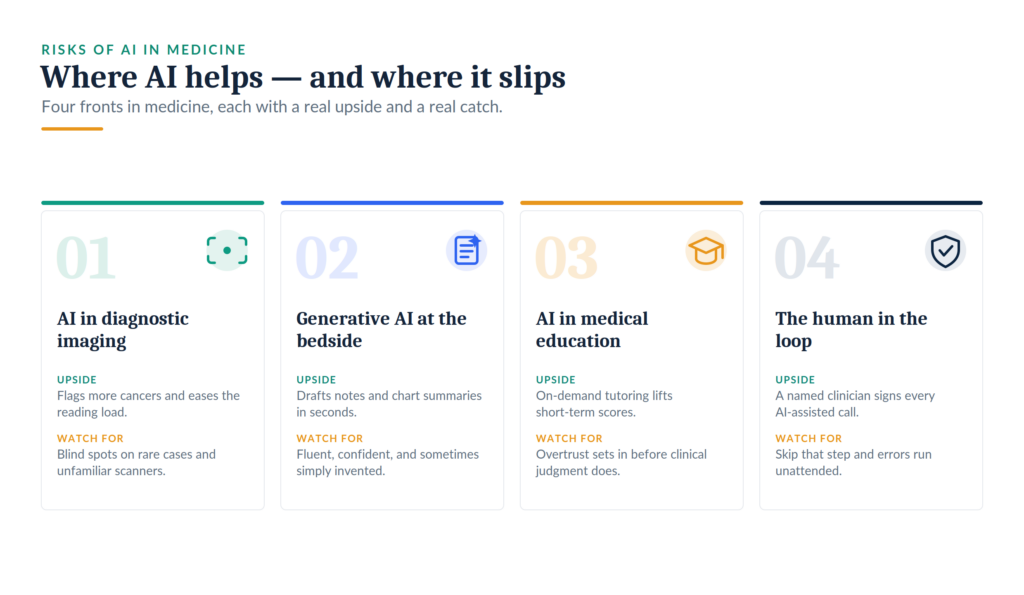
Now the risks associated with imaging. Two stand out. First, AI in diagnosing rare or atypical tumors still trails experts, and a confident miss reads as a clean scan. Without local checks, AI could skip the atypical case and delay a medical diagnosis. Second, accuracy drops on scanners and patient groups outside the training data. AI algorithms tuned in one country may stumble in another clinic.
Liability then turns thorny. Although AI can help flag a lesion, the radiologist signs the report and owns the error. Vendors disclaim, and regulators watch. Health care providers who deploy imaging AI need documented override rules and local validation before go-live. Otherwise a strong average hides the single case that reaches a courtroom.
Generative AI and Clinical Decision Support at the Bedside
Generative tools now draft discharge notes, summarize charts, and suggest differentials. The pull is obvious: clinicians drown in electronic health records, and an AI system can lighten that load. Yet a UCSF study in PLOS Digital Health [2] shows the catch.
Researchers fed 100 emergency department visits to GPT-4 and GPT-3.5. GPT-4 summaries looked polished, with outright inaccuracies in only 10% of cases. However, 42% contained a hallucination, and 47% dropped clinically relevant information. Only a third of GPT-4 notes came back fully error-free. These fabrications sit at the heart of the risks of artificial intelligence in medicine.
Here the AI system’s fluency becomes the hazard. A rushed clinician skims a clean-looking summary and misses a fabricated line. Since AI writes with confidence, silent omissions slip past review. Left unchecked, these risks of GPT-4-style errors compound across a shift.
Documentation and consent raise the stakes. A hallucinated note enters the health records and follows the patient as health information. Integrating AI at the bedside therefore demands human sign-off on every generated line. Speed without a check just moves the error downstream.
AI in Medical Education and Clinician Training
Medical education adopted these tools fast. AI tutors answer questions, generate practice cases, and simulate patients on demand. A randomized trial at Georgetown University School of Medicine tested the payoff [3].
Researchers split first-year students across three resources: ChatGPT-4.0, open sources like Google and PubMed, and internal lectures and textbooks. The AI group posted higher scores on the immediate quiz. So AI may lift short-term marks, which sounds like a clear win.
The catch appeared a week later. Retention showed no significant edge for the AI group over standard materials. In short, AI programs raised immediate scores but not durable knowledge. That gap matters when training AI users who will one day carry the tool into medical practice.
The quieter risk sits deeper. Trainees who use AI tutors can absorb model errors and skip the reasoning. Overtrust forms early, before clinical judgment sets. Because AI fundamentals now belong in every curriculum, schools must teach the tool and its failure modes together. Human intelligence still has to check the machine.
Where AI in Healthcare Is Heading Next
The next wave of artificial intelligence in healthcare adds autonomy. Agentic AI chains tasks together, while multimodal models read images, labs, and notes at once. Tighter integration of AI into the health care system means less friction, and also less human oversight. As autonomy rises, the risks of artificial intelligence in medicine shift from single wrong outputs to unattended chains of them.
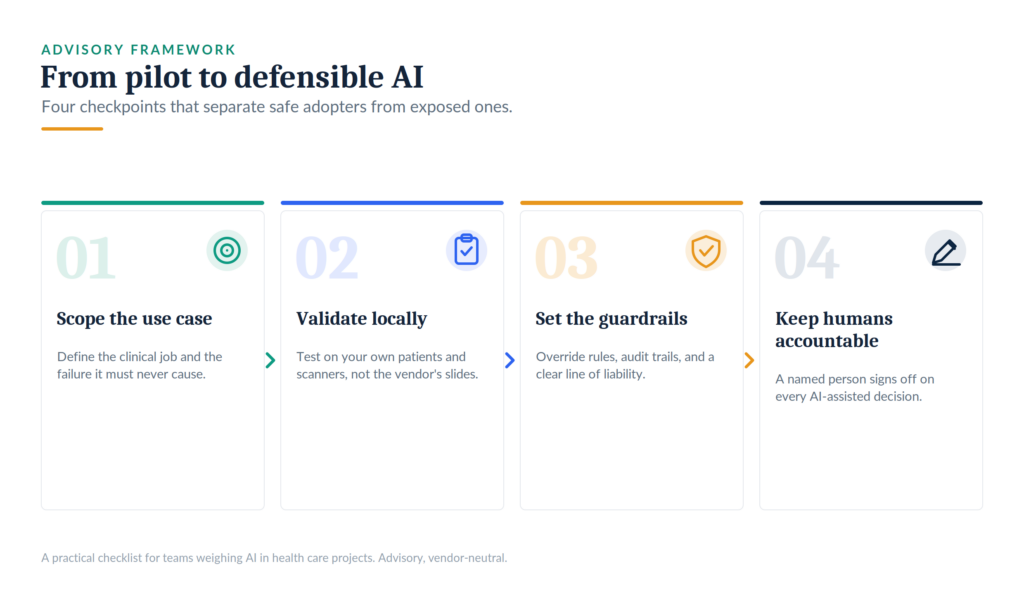
Capability alone will not make this safe. The American Medical Association and the National Institutes of Health both push for guardrails as adoption spreads. Practical governance now separates safe adopters from exposed ones. The essentials stay short:
- Audit trails: log what each AI system recommended and why.
- Local validation: test AI technologies on your own health data before launch.
- Clear liability: ensure that AI decisions carry a named, accountable human.
Done well, these tools reshape health care delivery across health systems. AI can predict deterioration hours early. AI can automate coding, and AI can also draft routine letters. Precision medicine sharpens with richer inputs. The role of AI grows, yet a human stays accountable. The responsible use of AI keeps a clinician in the loop at each step. That balance guards patients and limits health inequities baked into weak data. The era of artificial intelligence in care rewards teams that build controls first.
Bring AI Into Your Healthcare Workflow, Safely
Our team advises clinical directors and founders on the use of AI in health care projects. We guide it from first scoping to sign-off. We pressure-test the evidence, flag the liability risks, and set the guardrails that keep artificial intelligence in health care defensible. Weighing the risks of artificial intelligence in medicine before you commit? Reach out to our team for a working session.
References
- Eisemann, Nora, et al. “Nationwide real-world implementation of AI for cancer detection in population-based mammography screening.” Nature medicine 31.3 (2025): 917-924.
- Williams, Christopher YK, et al. “Evaluating large language models for drafting emergency department encounter summaries.” PLOS digital health 4.6 (2025): e0000899.
- Kalam, Kazi A., et al. “ChatGPT as a learning tool for medical students: results from a randomized controlled trial.” Cureus 17.6 (2025).