

Every day, millions of people use ChatGPT for questions that once went straight to a doctor. Meanwhile, clinicians and healthcare organizations quietly adopt the same OpenAI technology behind the scenes. ChatGPT in healthcare offers real benefits, yet it carries genuine limits and risks. This guide follows the evidence, not the hype.
What This Guide Covers: ChatGPT, OpenAI Models, and Their Role in Modern Healthcare
ChatGPT is an AI chatbot built by OpenAI on large language models, a form of generative AI trained on huge amounts of text. It predicts language, so it can answer questions, summarize records, and draft documents in plain medical terminology. This flexibility explains the rise of ChatGPT in healthcare and its fast-growing presence in medical literature.
One distinction matters before anything else. Developers did not design general-purpose tools like ChatGPT for clinical work. Purpose-built medical AI tools, by contrast, go through validation, monitoring, and often meet HIPAA compliance. Both rely on similar AI models, yet they differ sharply in testing, oversight, and accountability.
The research base is growing fast. A recent systematic review mapped many applications of chatgpt across diverse healthcare settings, from documentation to triage to patient education. Some results look strong, while others look weak – which is exactly why careful reading pays off.
This article keeps a simple shape. First, we show where ChatGPT can help healthcare providers today. Next, we mark what ChatGPT cannot do safely. Finally, we cover the risks that healthcare professionals must manage. Benefits, limits, and risks, in that order.
Why AI Chatbots Are Reshaping How Healthcare Organizations Operate
Healthcare runs under constant strain. Clinician burnout, administrative overload, and rising documentation demands push the whole healthcare system toward automation. Cheaper compute and stronger AI systems moved these tools from novelty to daily practice. Real uses of ChatGPT in healthcare now cluster around three tasks, shown below.
Clinical Documentation and Ambient Note-Taking: ChatGPT as a Physician’s Scribe
Documentation eats hours that clinicians would rather spend with patients. Ambient AI scribes listen to a visit, then draft structured notes such as SOAP notes, discharge summaries, and referral letters. Because ChatGPT can assist with this drafting, many vendors now build scribes on top of it.
A 2024 study in the Journal of Medical Internet Research [1] tested this exact use case. Researchers at Oregon Health & Science University fed transcribed patient encounters into ChatGPT-4 and asked for SOAP notes. The model produced a clean note every time, yet accuracy told a harder story.
Key findings:
Each note averaged 23.6 errors per case.
Omissions drove 86% of those errors.
Only 52.9% of data elements appeared correctly across three runs of the same case.
Longer transcripts led to lower accuracy.
The lesson is practical, not discouraging. ChatGPT can cut first-draft time and ease burnout, which is a genuine advantage of using it. Still, a healthcare professional must review every generated note before it reaches the record. Speed helps only when a human keeps final control.
Triage and Symptom-Checking Chatbots for Patient Intake
Patient-facing AI chatbots can gather symptoms, answer questions, and route people to the right level of care. They can also book appointments before staff step in. Done well, this shortens wait times and lightens front-desk load. Done poorly, it sends someone home who needed an emergency room.
A clinical data analysis study compared symptom checkers and ChatGPT against emergency physicians [2]. The team used deidentified records from 40 patients at a hospital emergency department. Then they scored both diagnosis and triage safety.
The triage numbers explain why guardrails matter:
| Tool | Agreed with physicians | Unsafe triage rate |
|---|---|---|
| ChatGPT 3.5 | 59% | 41% |
| ChatGPT 4.0 | 76% | 22% |
| Ada Health | 62% | 14% |
ChatGPT 4.0 matched physicians most often, yet it still under-triaged roughly one in five cases. The authors concluded that unsupervised patient use is not ready for prime time. For healthcare providers, the message is clear. A chatbot can guide intake, but a qualified clinician must own every decision about urgency.
Mental Healthcare Support: Conversational AI for Between-Session Care
Mental healthcare has a supply problem. Therapists are scarce, waitlists stretch for months, and support rarely shows up at 2 a.m. when someone needs it. Here, AI chatbots can fill part of the gap between sessions with mood check-ins, guided exercises, and quick psychoeducation.
A 2024 study in the journal Information [3] tested a chatbot built on ChatGPT for anxiety support. Fifty participants with mild to moderate anxiety used it across two seven-day phases. The chatbot delivered CBT techniques – cognitive restructuring, mindfulness, and breathing exercises – and stayed available around the clock.
The results were encouraging:
Anxiety symptoms fell by about 21% in the first phase.
Improvement held near 20% in the second phase.
Engagement rose as users grew familiar with the tool.
These numbers show real promise for mental health issues, especially where access stays limited. However, the risks run deep. A chatbot can miss a crisis, give unqualified health advice, or reinforce harmful thinking. Any mental health application therefore needs escalation protocols, clear limits, and human clinical oversight. Support, not substitution, is the only safe design.
The Future of ChatGPT in Healthcare: What’s Next for AI-Assisted Medicine
The next wave of ChatGPT in healthcare will look less like a chat box and more like an assistant wired into clinical systems. Several shifts already stand out:
Multimodal AI models that read medical imaging and lab results alongside text.
EHR integration, so notes and orders flow without copy-paste.
Specialized medical AI trained on health data rather than the open web.
Clearer rules, from the FDA to the EU AI Act, that treat some AI systems as medical devices.
Each shift raises the stakes. A tool that touches diagnosis or medication carries far more risk than one that drafts a letter. So oversight has to grow with capability.
Three conditions will decide whether this future helps or harms. First, validation: models need testing on real medical data before any rollout. Second, equity: poorly trained systems can widen health disparities instead of closing them. Third, privacy: sensitive health information demands strong protection, and HIPAA in the United States sets a floor for it.
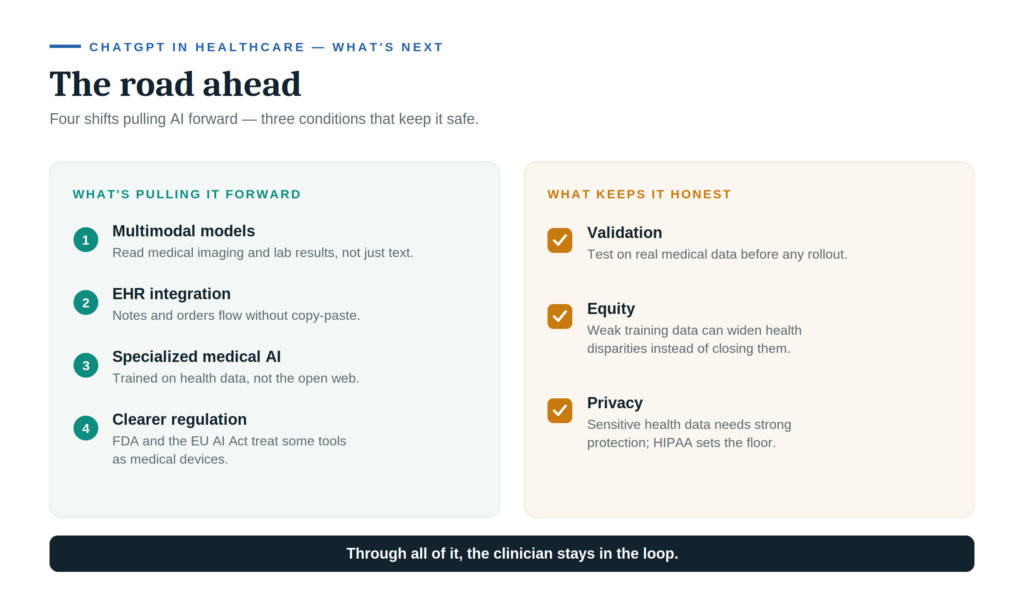
Advanced AI technology will keep improving, and that progress is welcome. Even so, the clinician stays in the loop, and better health outcomes remain the point. The future of ChatGPT in healthcare rewards teams that pair ambition with guardrails.
Bring AI Into Your Practice: Partner With Us on Healthcare Integration
Ready to bring AI into your practice safely? We help healthcare organizations design, deploy, and safeguard AI tools that fit real clinical workflows. Our focus stays on compliance, security, and clinical validation. Whether you run a small clinic or a health-tech team, let’s plan your approach to AI in healthcare delivery. Contact us to start the conversation.
References
Kernberg, Annessa, Jeffrey A. Gold, and Vishnu Mohan. “Using ChatGPT-4 to create structured medical notes from audio recordings of physician-patient encounters: comparative study.” Journal of medical Internet research 26 (2024): e54419.
Fraser, Hamish, et al. “Comparison of diagnostic and triage accuracy of Ada health and WebMD symptom checkers, ChatGPT, and physicians for patients in an emergency department: clinical data analysis study.” JMIR mHealth and uHealth 11.1 (2023): e49995.
Manole, Alexia, et al. “Harnessing AI in anxiety management: a chatbot-based intervention for personalized mental health support.” Information 15.12 (2024): 768.